


The Golden Ratio (Φ ≈ 1.618) is often called “the mathematical key to beauty.” It connects abstract numbers with visual harmony — appearing everywhere from classical temples to modern design, from the spirals of shells to the proportions of the human face.
If you’re curious about how mathematical concepts originated, you can explore the origins of zero and mathematical abstraction to see how ideas like the Golden Ratio evolved.
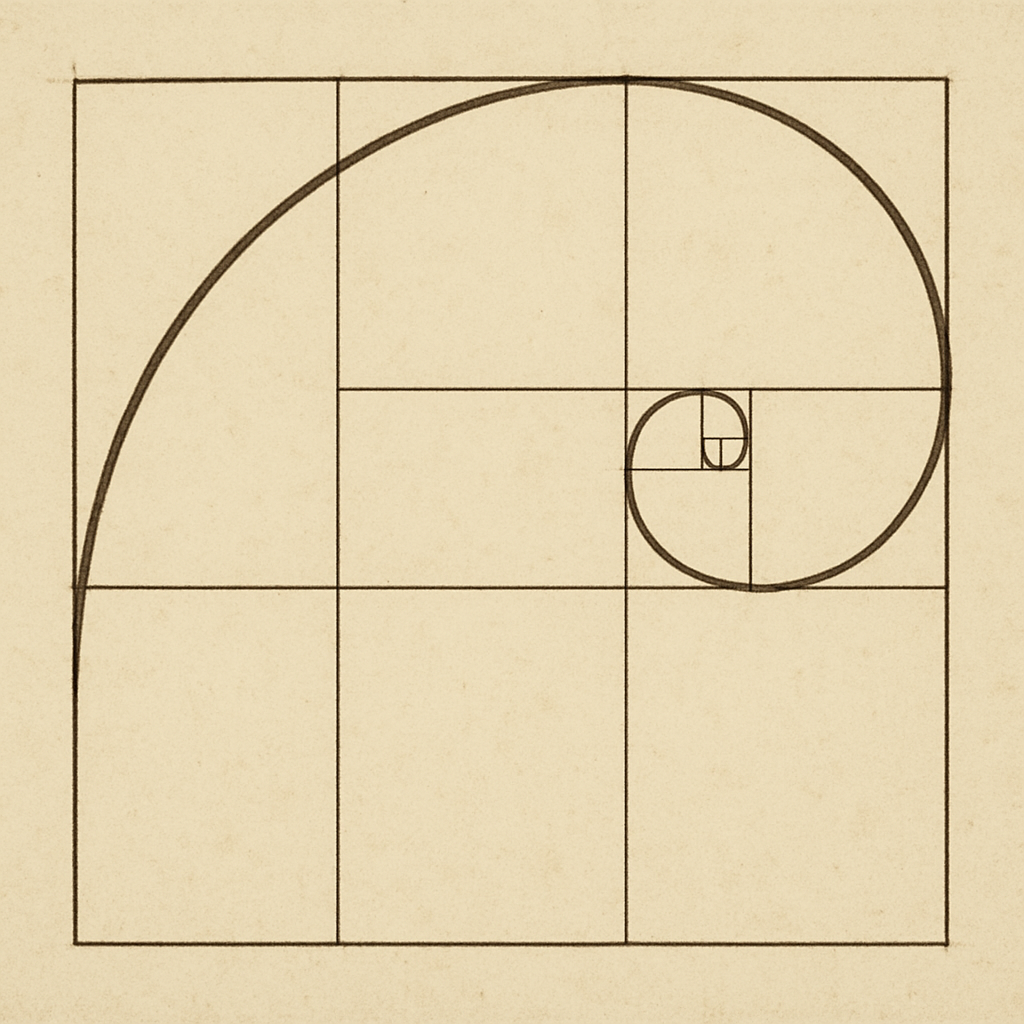
Understanding the Golden Ratio
The Golden Ratio comes from the Fibonacci sequence, where each number equals the sum of the two before it. As the sequence grows, the ratio between successive numbers approaches 1.618.
Mathematically, two numbers a and b are in the Golden Ratio when:
(a+b)/a=a/b≈1.618(a + b) / a = a / b ≈ 1.618(a+b)/a=a/b≈1.618
This proportion frequently appears in pentagons, spirals, and other geometric figures.
To help children recognize mathematical patterns early, you can check out how math pattern games nurture early math skills — a perfect way to connect pattern recognition with proportional thinking.
Golden Ratio in Art and Architecture
In Art: From Leonardo da Vinci’s Vitruvian Man to Salvador Dalí’s surreal compositions, artists have long used the Golden Ratio to guide balance and visual flow. It subtly directs the viewer’s gaze, creating a sense of rhythm and order.
In Architecture: The Parthenon in Athens and the Great Pyramids of Egypt are famous for their Golden Ratio proportions. Modern landmarks like the CN Tower and the United Nations Secretariat Building also reflect this timeless symmetry.
If you’d like to see how math education connects creative thinking with problem-solving, visit From Curriculum to Contest: How Ontario Math Prepares Students for Gauss, AMC, and Beyond

The use of the Golden Mean in art creates a sense of order and beauty. It guides the viewer’s eye through the artwork, creating an aesthetically pleasing experience.
Architecture and Proportion
The Golden Ratio is also prominent in architecture. Ancient structures like the Parthenon in Athens and the pyramids of Egypt reflect this ratio in their design. These structures are revered for their timeless beauty and proportion.
In modern architecture, the Golden Ratio continues to influence design. Buildings such as the United Nations Secretariat Building and the CN Tower incorporate this ratio, contributing to their iconic status.
The same sense of balance found in the Golden Ratio also applies to problem-solving in math contests.
Geometry questions in AMC 8, for instance, require students to visualize angles, areas, and proportions creatively.
Learn how to build those skills in AMC 8 Geometry Worksheets and Formula Guide | Think Academy Canada.
The Golden Ratio in Nature and the Human Body
You can find the Golden Ratio in nature everywhere — from the spirals of sunflower seeds and pinecones to the curves of nautilus shells and the arrangement of flower petals.
Even the human body follows these proportions: the ratio between the forearm and hand, or the spacing of facial features, often approximates Φ.
To turn curiosity about patterns in nature into real learning, check out Top 9 Free Educational & Math Contest Websites for Kids (2025 Edition), a curated list of high-quality math learning resources.
Golden Ratio Face Calculator
A Golden Ratio face calculator uses this proportion to analyze facial symmetry. It measures key facial distances — between the eyes, nose, lips, and chin — and compares them to the ideal Golden Ratio.
It’s a fun way to explore how symmetry works, but remember: beauty isn’t defined by numbers alone.
For students learning to decode structure and proportion in text, our Why Kids Struggle to Read Math Problems — ITA Method Insights offers great insights on how to understand and visualize complex math problems.
The Significance of the Golden Ratio
The allure of the Golden Ratio lies in its universal appeal and its ability to bring a sense of harmony and balance. Whether in art, architecture, or nature, this ratio enhances the beauty and structure of the world around us.
Modern Applications: From Photography to Design
Today, the Golden Ratio is widely used in graphic design, architecture, and photography composition.
Designers rely on the Golden Spiral to create visual balance, while photographers use it to guide framing — naturally leading the viewer’s eye toward the subject. Understanding these proportions helps students and creators alike transform “looking good” into “designing with intent.”
Conclusion: Finding Balance in Numbers
The Golden Ratio bridges math and beauty. It’s not the only formula for perfection, but it shows why humans are drawn to balance, symmetry, and order.
By noticing and applying this proportion in art, architecture, or even photography, you’ll see how mathematical thinking can reveal — and enhance — the world’s hidden harmony.


Really enjoyed this post, is there any way I can get an email sent to me when you publish a new update?