


As children move through elementary school in Canada, math learning gradually shifts from basic number skills to real-world application. One important example of this transition is financial literacy, which is not taught as a separate subject, but embedded directly within the elementary math curriculum.
Understanding how financial literacy fits into math learning helps parents see why certain topics are taught, when they appear, and how they support long-term mathematical thinking, not just everyday money skills.
Financial Literacy as Part of Math Learning
In Canadian classrooms, financial literacy is closely tied to core math concepts such as number sense, operations, fractions, decimals, and proportional reasoning. Rather than focusing on personal finance theory, elementary math uses money-related contexts to strengthen understanding of numbers and problem-solving.
Students learn to:
- interpret quantities and values
- compare numbers meaningfully
- apply operations in real situations
- reason through multi-step problems
This approach ensures financial literacy supports mathematical understanding instead of replacing it.
Early Elementary (Grades K–3): Understanding Quantity and Value
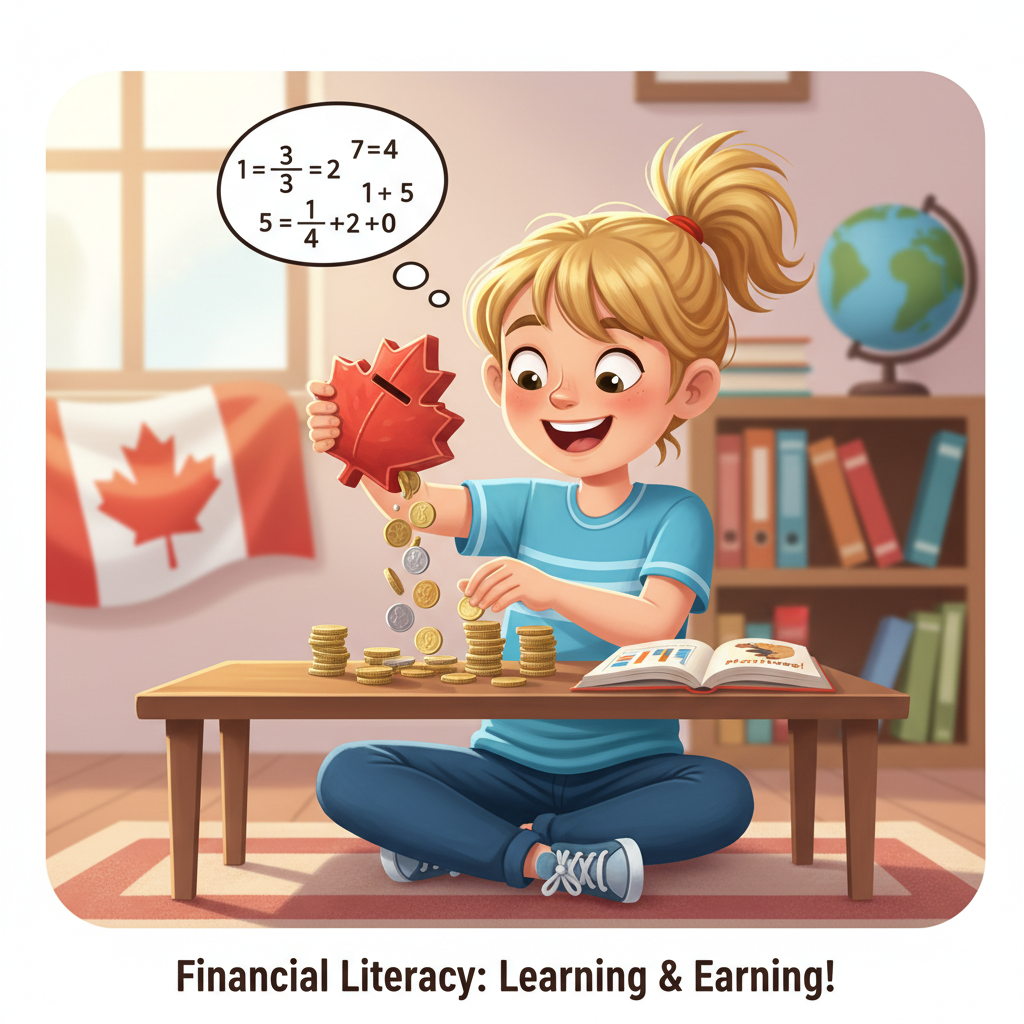
In the early grades, financial literacy appears through number sense and numeration. Children begin by recognizing Canadian coins and bills and understanding that numbers represent quantities with value.
At this stage, math learning focuses on:
- counting and comparing amounts
- understanding that different coin combinations can represent the same value
- simple addition and subtraction using money contexts
For example, students may explore how two $1 coins equal a $2 coin, reinforcing both quantity and equivalence. These activities support foundational math skills rather than memorization of prices.
Middle Elementary (Grades 4–5): Applying Operations and Place Value
As students progress, financial contexts become more complex and closely aligned with grade-level math expectations. Financial literacy now supports:
- multi-digit addition and subtraction
- multiplication and division
- understanding place value with larger numbers
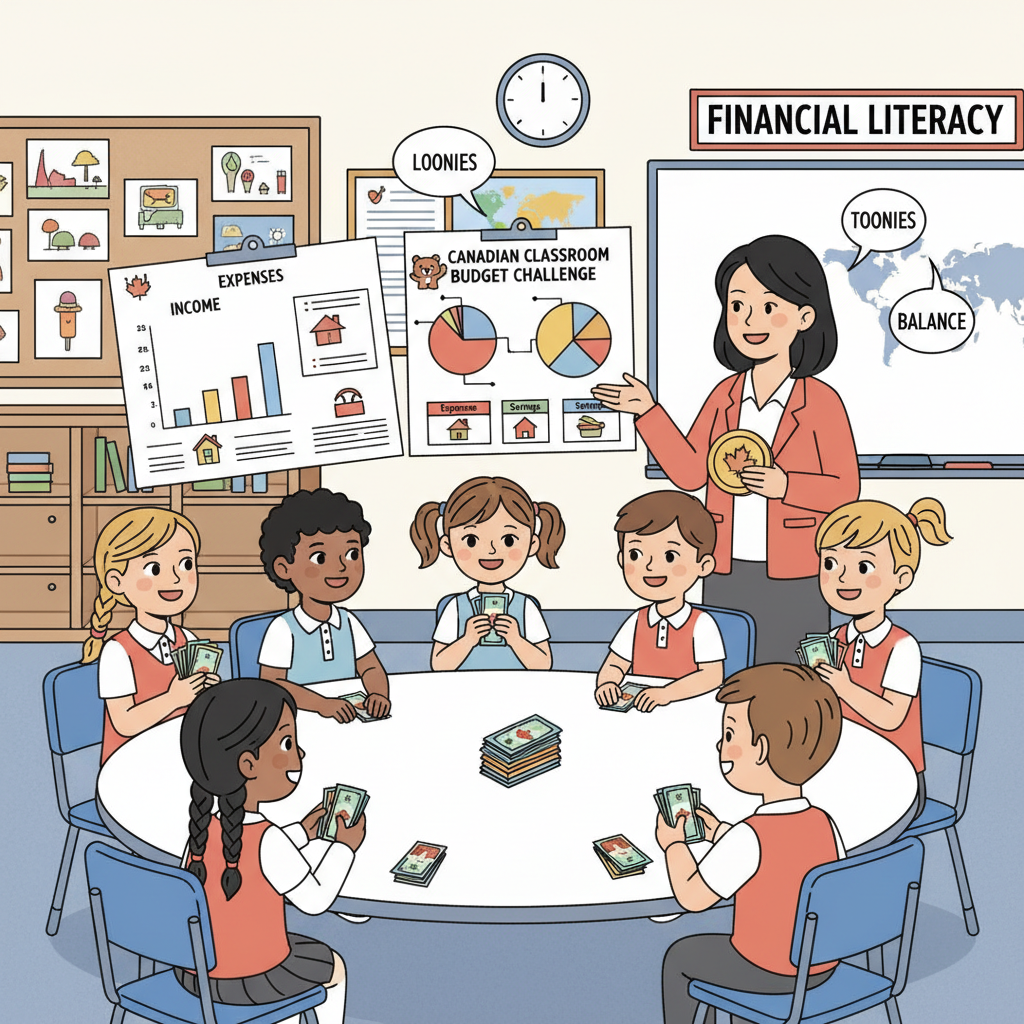
Students may work on problems involving budgeting scenarios, cost comparison, or calculating totals. These tasks strengthen accuracy, estimation, and reasoning—skills central to the math curriculum.
At this stage, children are not expected to manage real finances, but to apply math concepts in familiar, meaningful situations.
Upper Elementary (Grades 6–7): Fractions, Decimals, and Proportional Thinking
In later elementary grades, financial literacy supports more abstract math learning. Students apply fractions, decimals, ratios, and percentages to real-world problems involving money.
Typical learning goals include:
- understanding decimals as part of a whole
- comparing values using percentages
- interpreting simple interest or rate-based problems
- explaining reasoning using math language
These concepts prepare students for algebraic thinking by emphasizing relationships between quantities rather than isolated calculations. the groundwork for more intricate financial decisions in their teenage years and adulthood.
Why Financial Literacy Strengthens Math Foundations
When financial contexts are used well, they:
- make abstract math more concrete
- reinforce number relationships
- encourage multi-step problem solving
- develop reasoning and explanation skills
However, without strong math foundations, financial problems can become confusing rather than helpful. Students who struggle with place value, fractions, or operations may find money-related problems overwhelming.
How Parents Can Support Curriculum-Based Learning at Home
Parents can support financial literacy by reinforcing math thinking, not by teaching advanced finance concepts.
Helpful strategies include:
- asking children to explain how they calculated a total
- discussing why one option costs more than another
- encouraging estimation before exact calculation
- revisiting foundational skills when children struggle
These conversations align closely with classroom expectations and strengthen understanding without pressure.
Building Confidence Through Structured Math Learning
Financial literacy works best when children feel confident with numbers. Clear explanations, guided practice, and structured progression help students apply math concepts accurately and independently.
Wondering whether your child is ready to handle real-world math applications like financial problems?
Join a Free Trial Class to experience how Think Academy helps students build strong math foundations and apply them confidently across the elementary curriculum.
About Think Academy
Think Academy, part of TAL Education Group, supports K–12 students by strengthening math foundations and developing critical thinking skills. Our curriculum-aligned instruction helps students progress from basic number sense to advanced problem solving with clarity and confidence.
Through experienced teachers, research-based methods, and thoughtful use of technology, Think Academy supports each child’s journey from classroom learning to real-world application.
Want more insights into Canadian math learning and curriculum topics?
Subscribe to the Think Academy Blog for weekly tips and practical guidance.

