


As children move through elementary school, math learning develops in clear stages. Many parents want to support their child but aren’t always sure what skills are expected at each grade level—or when a small gap might turn into a bigger challenge.
Understanding elementary math milestones from Kindergarten through Grade 6 helps parents recognize what their child is learning, what comes next, and how to offer support with confidence. These milestones reflect how Canadian curricula build math understanding step by step, laying the groundwork for future success.
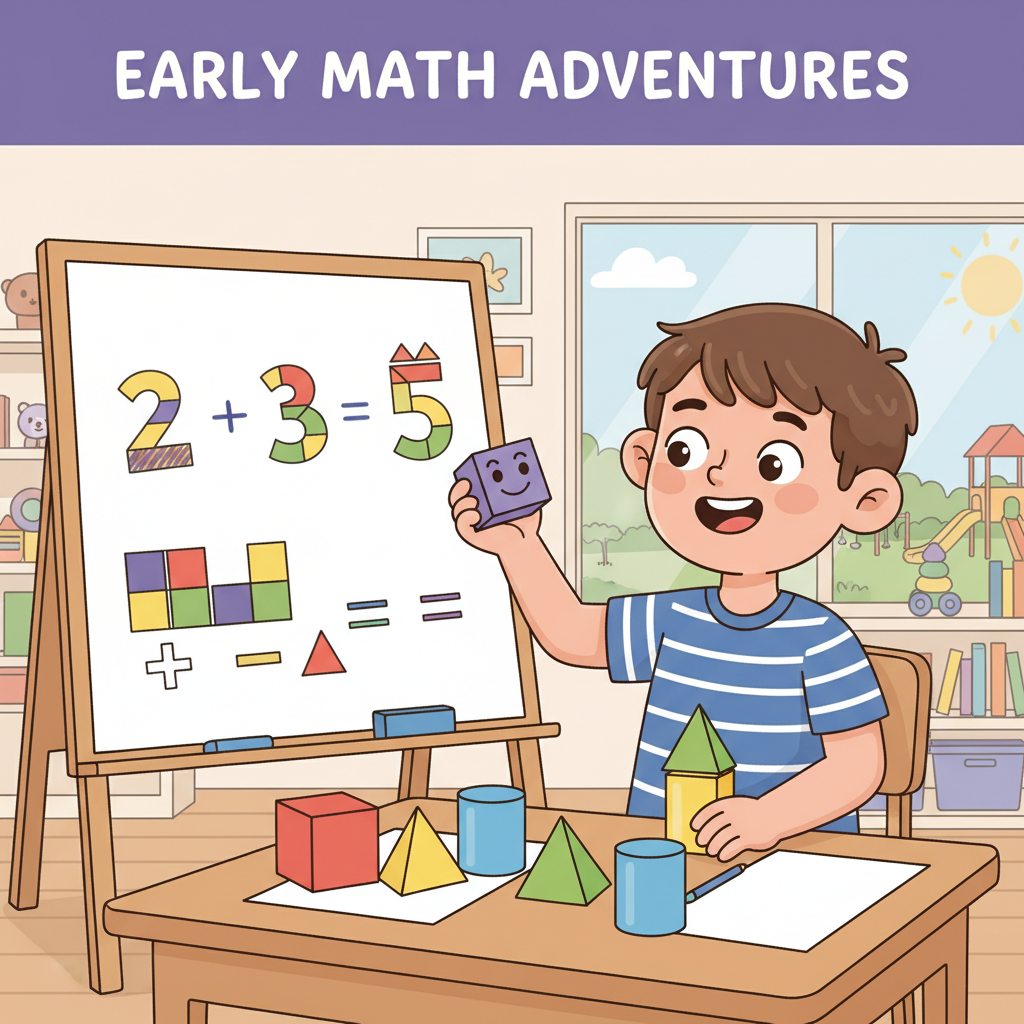
Early Elementary Math Milestones (Grades K–3)
The early elementary years focus on building the foundations of math learning. At this stage, children develop number sense, the ability to understand, compare, and work flexibly with numbers. This foundation supports all future math learning.
In Kindergarten, children typically learn to:
- count and recognize numbers
- identify patterns
- understand simple quantities
By Grade 1, students begin working with basic addition and subtraction, usually within 10. They also explore two-dimensional and three-dimensional shapes, learning to recognize and describe them.
In Grades 2 and 3, children expand their understanding to larger numbers, often up to 1,000. They develop strategies for adding and subtracting two- and three-digit numbers and begin working with measurement concepts such as length, mass, and time. Learning is still highly hands-on, using visual models and real-life examples to build understanding rather than relying on memorization alone.
These early milestones are critical. Gaps at this stage, especially in number sense, can affect confidence and progress later on.
Upper Elementary Math Milestones (Grades 4-6)
The upper elementary grades introduce more abstract and complex mathematical concepts, building significantly on earlier learning. Children transition from concrete understanding to more formal problem-solving approaches. This is where multiplication and division become central to their learning.
By Grade 4, children are expected to have a solid grasp of multiplication and division facts. They begin to apply these operations to solve multi-step problems, moving beyond simple calculations. Furthermore, students are introduced to fractions and decimals, understanding their equivalence and performing basic operations with them. They also delve deeper into geometry, exploring angles, perimeter, and area.

In Grades 5 and 6, the curriculum further refines these skills. Students work with larger numbers, more complex fractions and decimals, and begin to explore ratios and percentages. They are also introduced to algebraic thinking, learning to use variables to represent unknown quantities in simple equations. Data management and probability become more sophisticated, involving the interpretation of various graphs and the calculation of probabilities. Therefore, these years are pivotal for developing critical thinking and problem-solving strategies that will serve them well in middle school and beyond.
How Parents Can Support Math Development at Every Stage
Parents play a powerful role in supporting math learning, regardless of grade level.
Start by fostering a positive attitude toward math. Avoid sharing negative experiences or anxieties, and instead emphasize effort, curiosity, and persistence. Children often mirror how adults talk about learning.
Bring math into everyday life:
- measure ingredients while cooking
- compare prices while shopping
- estimate time or distance during daily routines
These real-world connections help children see math as useful and meaningful.
Why Tracking Math Milestones Matters
Elementary math milestones aren’t about rushing ahead—they’re about ensuring understanding at each stage. When children master foundational skills, they approach new concepts with confidence instead of anxiety.
Wondering whether your child is meeting key math milestones—or might benefit from extra guidance?
Join a Free Trial Class to experience how Think Academy helps students strengthen foundations, build problem-solving skills, and progress confidently through each stage of math learning.
Regular communication with teachers is also key. If a child struggles with a topic like fractions or multiplication, revisiting earlier concepts, such as equal grouping or place value—often helps rebuild understanding. Supplementary resources can be helpful, but the focus should remain on clarity and confidence rather than speed.
About Think Academy
Think Academy, part of TAL Education Group, helps K–12 students succeed in school today by building strong math foundations and critical thinking skills. At the same time, we focus on the bigger picture—developing learning ability, curiosity, and healthy study habits that inspire a lifelong love of learning. With expert teachers, proven methods, and innovative AI tools, we support every child’s journey from classroom confidence to long-term growth.
Want more insights into math learning and parenting? Subscribe to our newsletter for weekly tips and the latest resources.
Explore grade-specific math programs designed for Canadian students.

