


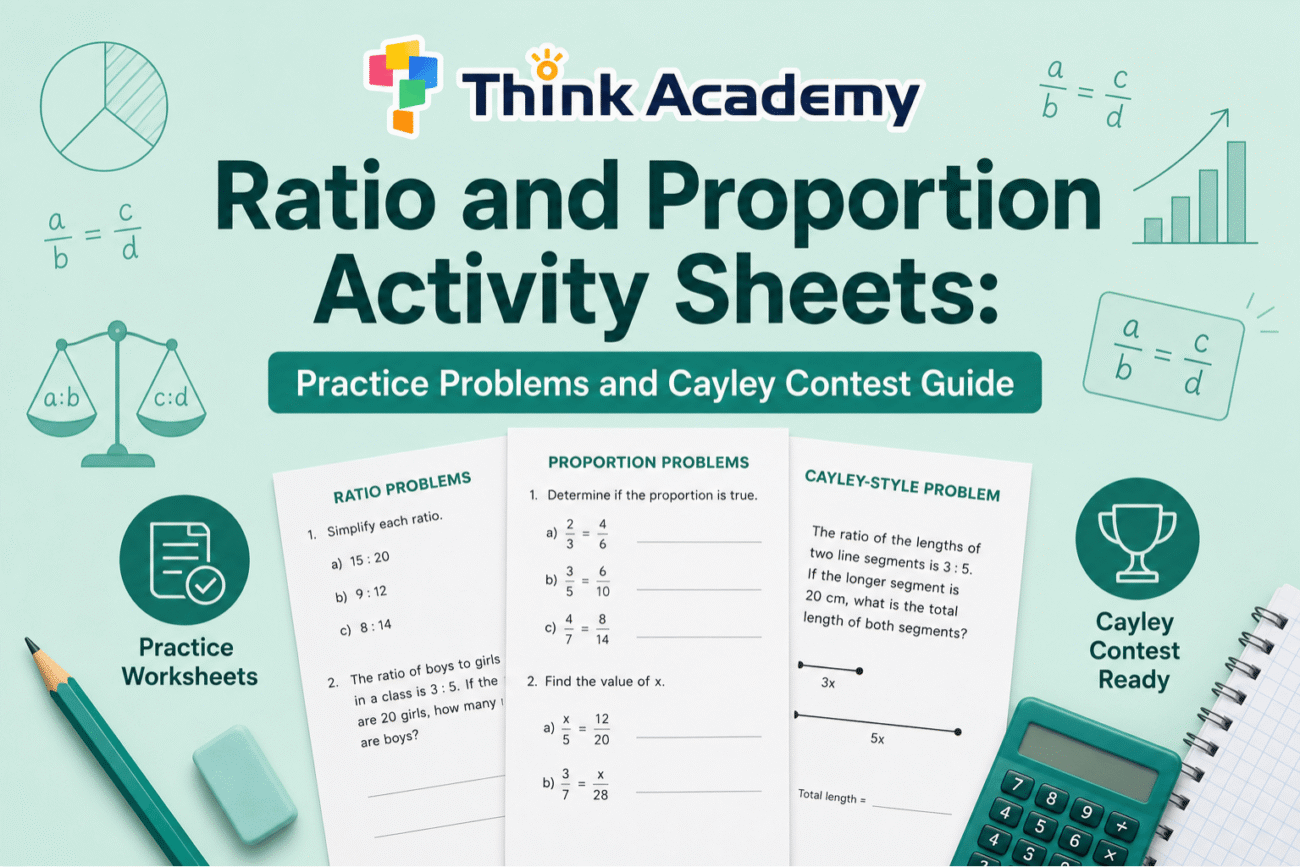
Ratio and proportion are two of the most widely applied concepts in mathematics. They appear in geometry, trigonometry, algebra, and data — and they underpin a significant portion of the problem-solving that the Cayley Contest tests. This guide to ratio and proportion activity sheets covers both concepts clearly, works through the problem types your child will encounter in Grade 9–10 Ontario math, and includes printable activity sheet problems for practice.

What is a ratio?
A ratio compares two or more quantities of the same kind. It tells you how much of one thing there is relative to another.
A ratio can be written in three ways:
| Format | Example |
|---|---|
| Using a colon | 3 : 5 |
| As a fraction | 3/5 |
| In words | 3 to 5 |
If a class has 12 boys and 18 girls, the ratio of boys to girls is 12 : 18, which simplifies to 2 : 3. This means for every 2 boys there are 3 girls.
Simplifying ratios
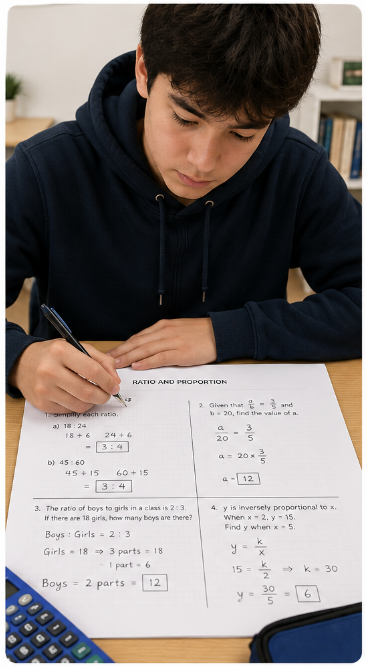
Ratios are simplified by dividing both terms by their greatest common factor (GCF). The ratio 24 : 36 simplifies to 2 : 3 (dividing both by 12).
For three-part ratios, the same rule applies. The ratio 6 : 9 : 15 simplifies to 2 : 3 : 5 (dividing all three terms by 3).
Part-to-part vs part-to-whole
A ratio can compare:
- Part to part: boys to girls (12 : 18)
- Part to whole: boys to total students (12 : 30, or 2 : 5)
Knowing which type of ratio a problem is using is the first step in setting it up correctly.
What is a proportion?
A proportion is a statement that two ratios are equal.
If a/b = c/d, then a, b, c, and d are in proportion.
For example: 2/3 = 8/12 is a proportion, because both ratios simplify to the same value.
The cross-multiplication rule
If a/b = c/d, then a × d = b × c.
This is the most useful tool for solving proportion problems where one value is unknown.
Example: If 3/4 = x/20, find x.
Cross-multiply: 3 × 20 = 4 × x 60 = 4x x = 15
The unitary method
An alternative approach: find the value of one unit first, then scale up or down.
Example: If 5 notebooks cost $8.50, how much do 8 notebooks cost?
Cost of 1 notebook = 8.50 ÷ 5 = $1.70 Cost of 8 notebooks = 1.70 × 8 = $13.60
The unitary method is particularly useful for rate and proportion word problems, which appear regularly on the Cayley Contest.
Ratio and proportion activity sheets: practice problems
Work through these problems. Worked solutions follow each set.
Set 1: Ratios
Q1. Simplify the ratio 45 : 60.
Q2. A bag contains red and blue marbles in the ratio 3 : 7. If there are 21 blue marbles, how many red marbles are there?
Q3. The ratio of length to width of a rectangle is 5 : 2. If the perimeter is 84 cm, find the length and width.
Q4. Three friends share $180 in the ratio 2 : 3 : 4. How much does each person receive?
Q5. A recipe uses flour, sugar, and butter in the ratio 6 : 2 : 1. If the total mixture weighs 450 g, how much flour is used?
Solutions — Set 1
Q1. GCF of 45 and 60 is 15. 45 ÷ 15 = 3, 60 ÷ 15 = 4. Simplified ratio: 3 : 4
Q2. The ratio is 3 : 7. Blue = 7 parts = 21 marbles, so 1 part = 3 marbles. Red = 3 parts = 9 marbles
Q3. Total parts = 5 + 2 = 7. Perimeter = 2(l + w) = 84, so l + w = 42. Length = (5/7) × 42 = 30 cm. Width = (2/7) × 42 = 12 cm
Q4. Total parts = 2 + 3 + 4 = 9. One part = 180 ÷ 9 = $20. Shares: $40, $60, $80
Q5. Total parts = 6 + 2 + 1 = 9. Flour = (6/9) × 450 = 300 g
Set 2: Proportions
Q1. Solve for x: 5/8 = x/40
Q2. A car travels 150 km in 2.5 hours. At the same rate, how far does it travel in 4 hours?
Q3. If 7 workers can complete a job in 12 days, how many days would 4 workers take (assuming the same rate)?
Q4. A map uses a scale of 1 : 50,000. Two cities are 6 cm apart on the map. What is the actual distance in kilometres?
Q5. Solve for x: (x + 2)/5 = (x − 1)/3
Solutions — Set 2
Q1. Cross-multiply: 5 × 40 = 8 × x → 200 = 8x → x = 25
Q2. Rate = 150 ÷ 2.5 = 60 km/h. Distance in 4 hours = 60 × 4 = 240 km
Q3. Total work = 7 × 12 = 84 worker-days. Time for 4 workers = 84 ÷ 4 = 21 days
Q4. Actual distance = 6 × 50,000 = 300,000 cm = 3 km
Q5. Cross-multiply: 3(x + 2) = 5(x − 1) 3x + 6 = 5x − 5 11 = 2x x = 5.5
Ratio and proportion in the Ontario Grade 9–10 curriculum
Ratio and proportion run through several strands of the Ontario math curriculum at the Grade 9 and 10 level.
MTH1W (Grade 9): Students pose and solve problems involving rates, percentages, and proportions in various contexts, including data, measurement, geometry, and financial literacy. Proportional reasoning is embedded across the course rather than confined to a single unit.
MPM2D (Grade 10): Ratio and proportion appear most explicitly in the similarity and trigonometry strand. Students use their knowledge of ratio and proportion to investigate similar triangles and solve problems related to similarity. The primary trigonometric ratios — sine, cosine, and tangent — are themselves ratios of side lengths in right triangles.
| Curriculum connection | What it looks like |
|---|---|
| Grade 9 rates and proportions | Solving proportion equations; unit rates; percent problems |
| Grade 9 geometry | Scale diagrams; similar figures |
| Grade 10 similar triangles | Corresponding sides in proportion; finding missing lengths |
| Grade 10 trigonometry | SOH CAH TOA as ratio of sides; solving for angles and sides |
| Grade 9–10 data | Reading and interpreting ratios in graphs and statistics |
Ratio and proportion in the Cayley Contest
The Cayley Contest is a 25-question multiple-choice competition run by the University of Waterloo’s CEMC, written by Grade 10 students. Like all CEMC contests, it tests mathematical reasoning and problem-solving rather than content recall directly.
Why practice using ratio and proportion activity sheets?
Ratio and proportion appear in Cayley problems in several forms:
Direct proportion problems: Given a relationship between two quantities, find a missing value. These are typically short Part A problems (worth 5 marks each) and reward students who can set up a proportion equation quickly.
Geometric ratio problems: Similar triangles, scale factors, and problems involving the ratio of areas or perimeters. A student who knows that the ratio of areas of similar figures is the square of the ratio of corresponding sides has a significant advantage on geometry problems.
Rate reasoning: Problems involving speed, density, concentration, or other rates where setting up a proportion is the key step. The unitary method is often the most efficient approach.
Multi-step proportion problems: More complex Cayley problems embed proportion within a larger problem — for example, finding a ratio of areas after a transformation, or using proportional reasoning inside an algebraic problem. These appear in Part C (worth 8 marks each) and reward flexible thinking.
A student who is fluent with cross-multiplication, the unitary method, and proportional reasoning in geometry will handle the ratio-heavy Cayley problems efficiently — leaving more time for the harder combinatorics and number theory questions.

Ratio and proportion activity sheets: Similar triangles and proportion – a key Cayley connection
Similar triangles are one of the most tested geometric concepts on the Cayley Contest, and they are entirely built on proportional reasoning.
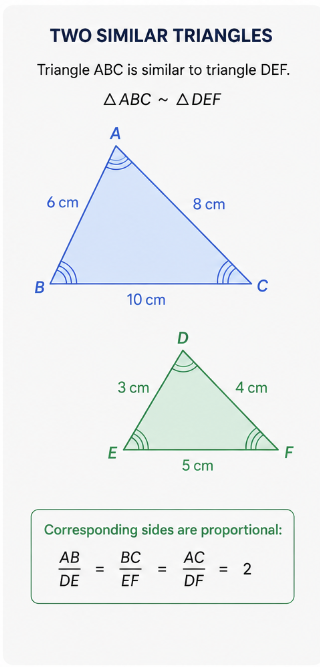
Two triangles are similar if their corresponding angles are equal. When they are similar, their corresponding sides are in proportion.
If triangle ABC is similar to triangle DEF, then:
AB/DE = BC/EF = AC/DF
This means any unknown side can be found by setting up and solving a proportion.
Example: Triangle ABC has sides 6, 8, and 10. Triangle DEF is similar to ABC and has its shortest side equal to 9. Find the other two sides of DEF.
Scale factor = 9/6 = 1.5
Second side = 8 × 1.5 = 12 Third side = 10 × 1.5 = 15
The ratio of areas of similar figures equals the square of the scale factor. If the scale factor is 1.5, the ratio of areas is 1.5² = 2.25.
Ratio and proportion activity sheets: Direct and inverse proportion
Direct proportion
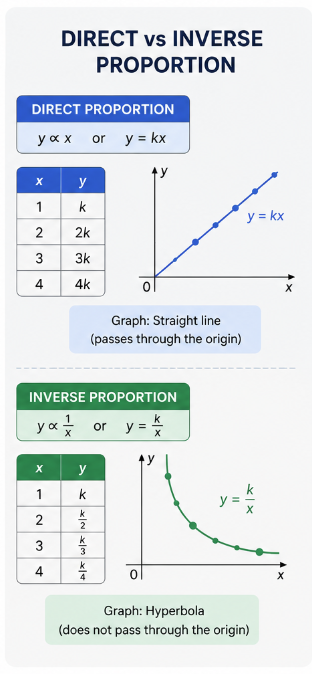
Two quantities are in direct proportion if they increase or decrease at the same rate. If y is directly proportional to x:
y = kx (where k is the constant of proportionality)
If y = 12 when x = 4, then k = 3. So y = 3x. When x = 7, y = 21.
Inverse proportion
Two quantities are in inverse proportion if one increases as the other decreases at the same rate. If y is inversely proportional to x:
y = k/x (or xy = k)
The worker problem in Set 2 above (more workers → fewer days) is an example of inverse proportion. If 7 workers take 12 days, k = 7 × 12 = 84. Four workers take 84/4 = 21 days.
| Type | Relationship | Formula |
|---|---|---|
| Direct proportion | As x increases, y increases | y = kx |
| Inverse proportion | As x increases, y decreases | y = k/x or xy = k |
Cayley Contest problems sometimes test whether students can correctly identify which type of proportion applies before solving — a reasoning step that trips up students who jump to calculation too quickly.
Ratio and proportion activity sheets: How Think Academy Canada supports Cayley Contest preparation
Think Academy Canada works with high-performing Ontario students from Grade 1 through Grade 12. For students preparing for the Cayley Contest, our programme covers the core mathematical skills the contest draws on — including ratio and proportion in algebraic and geometric contexts, similar triangles, trigonometric ratios, and the multi-step reasoning that Part C problems require.
Our approach starts with a free diagnostic. Every new student completes a short assessment involving ratio and proportion activity sheets, and receives a personalised feedback report identifying where their skills sit, plus resources to practice with. For students targeting the Cayley Contest, the report highlights the specific areas — whether that is algebraic proportion, geometric similarity, or problem-solving strategy — that will have the most impact on their score.
The Cayley Contest is written in February each year. Students who begin structured preparation in the autumn have the most time to build fluency across all the relevant topics.
FAQs
What is the difference between ratio and proportion?
A ratio compares two quantities. A proportion is a statement that two ratios are equal. For example, 2 : 3 is a ratio. The statement 2/3 = 8/12 is a proportion.
How do you solve a proportion?
The most common method is cross-multiplication. If a/b = c/d, then a × d = b × c. Solve the resulting equation for the unknown variable. The unitary method (finding the value of one unit first) is an alternative that works well for rate problems.
What is direct proportion?
Two quantities are in direct proportion when they increase or decrease at the same rate. If you double one, the other doubles. The relationship is y = kx, where k is a constant.
What is inverse proportion?
Two quantities are in inverse proportion when one increases as the other decreases at the same rate. The relationship is xy = k. The classic example is workers and time: more workers completing a task means less time required.
How does ratio and proportion appear in the Cayley Contest?
Ratio and proportion appear in Cayley problems as direct proportion equations, geometric similarity problems (including similar triangles and scale factors), rate reasoning problems, and multi-step problems where proportional reasoning is embedded within a larger algebraic or geometric context.
What are similar triangles and how do they use proportion?
Two triangles are similar if their corresponding angles are equal. Their corresponding sides are in proportion — meaning the ratio of any pair of corresponding sides is the same. This ratio is called the scale factor. Finding missing sides in similar triangles is a standard proportion application in Grade 10 math and the Cayley Contest.
How do trigonometric ratios connect to proportion?
The trigonometric ratios (sine, cosine, tangent) are ratios of side lengths in right triangles. They work because similar right triangles have the same angle measures and therefore the same side ratios. This is why sin, cos, and tan are constant for a given angle regardless of the triangle’s size.
What is the unitary method?
The unitary method solves proportion problems by first finding the value of one unit, then scaling. For example: if 6 items cost $15, one item costs $2.50, and 10 items cost $25. It is a reliable and flexible approach for rate and proportion word problems.
How do you simplify a ratio?
Divide all terms of the ratio by their greatest common factor. For a two-part ratio like 24 : 36, the GCF is 12, giving 2 : 3. For three-part ratios like 6 : 9 : 15, the GCF is 3, giving 2 : 3 : 5.
Is ratio and proportion on the Ontario Grade 10 math curriculum?
Yes. Ratio and proportion are explicitly part of MPM2D (Grade 10 Academic) in the similarity and trigonometry strand. Students use ratio and proportion to investigate similar triangles and solve problems involving the primary trigonometric ratios. Proportional reasoning also runs through Grade 9 MTH1W across multiple strands.
What is the Cayley Contest and who should enter?
The Cayley Contest is a 25-question multiple-choice mathematics competition run by the University of Waterloo’s CEMC. It is written by Grade 10 students, though strong Grade 9 students may also be eligible. It tests mathematical reasoning and problem-solving. The contest is written in February each year.
How can Think Academy Canada help with ratio and proportion?
Think Academy Canada offers a free diagnostic assessment for students in Grades 1 to 12. The assessment produces a personalised feedback report showing where a student’s skills sit, including their handling of proportional reasoning, algebraic equations, and geometric similarity. For students preparing for the Cayley Contest, this gives a precise starting point for preparation.
About Think Academy Canada Think Academy Canada is a K-12 mathematics tutoring programme, part of TAL Education Group. We work with motivated students across Canada from Grade 1 through Grade 12, with a focus on Ontario curriculum, EQAO, and competition mathematics including CEMC contests (Pascal, Cayley, Fermat, Euclid) and AMC. All lessons are delivered online. Follow us on Instagram at @thinkacademyca.


These look really helpful for my students. It’s great to have a guide like this alongside the practice sheets.