



A parent who discovers their child is strong in math faces an immediate question: what next? School curriculum has a ceiling. Math competitions are designed specifically for what comes after that ceiling — structured, externally validated challenges that develop the reasoning skills school doesn’t. But the landscape is bigger than most parents realise, and choosing the wrong level — too easy or too hard — wastes a year of preparation time. This guide covers every major math competition available to Canadian students, what each one tests, and how to figure out which one is right for your child right now.
If you’re still at the earlier stage of wondering whether your child has the mathematical ability to compete seriously, our guide to signs of mathematical giftedness is the right starting point.
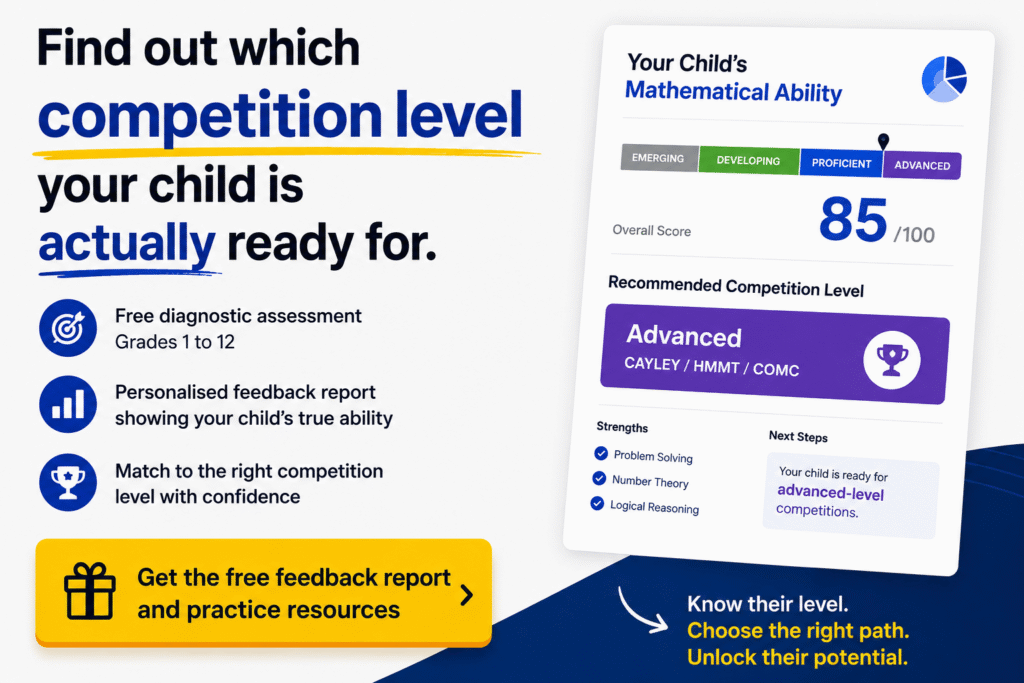
The two main math competition pathways for Canadian students
Canadian students have access to two major competition pathways, each with a different focus and a different university recognition profile.
The CEMC pathway (University of Waterloo)
The Centre for Education in Mathematics and Computing (CEMC) at the University of Waterloo runs Canada’s most widely recognised mathematics contest series. Over 300,000 students in more than 85 countries participate each year. The CEMC pathway runs from Grade 7 through Grade 12 and is the primary competition route for students targeting Canadian universities, particularly the University of Waterloo’s highly competitive mathematics, computer science, and engineering programmes.
The AMC pathway (Mathematical Association of America)
The American Mathematics Competitions (AMC) series is run by the Mathematical Association of America and is the primary pathway for students targeting US and international university admissions. It is equally available to Canadian students and is the route to AIME (American Invitational Mathematics Examination) qualification. Many strong Canadian students participate in both pathways — preparation for one directly benefits performance in the other.
CEMC contests: the full ladder
The CEMC contest series is structured as a pathway, with each contest designed for a specific grade level and building directly toward the next.
| Contest | Grade | Format | When |
|---|---|---|---|
| Gauss | 7–8 | 25 multiple choice, 60 min | May |
| Pascal | 9 | 25 multiple choice, 60 min | February |
| Cayley | 10 | 25 multiple choice, 60 min | February |
| Fermat | 11 | 25 multiple choice, 60 min | February |
| Euclid | 12 | 10 full-solution questions, 150 min | April |
Gauss Contest (Grades 7–8) — the entry point to the CEMC pathway. The most widely sat of all CEMC contests, with two versions: Grade 7 and Grade 8. Tests number sense, algebra, geometry, counting, and probability through non-routine multiple choice problems. Registration for the 2026/27 cycle opens September 2026.
Pascal, Cayley, and Fermat Contests (Grades 9, 10, 11) — three parallel contests at increasing difficulty levels, each designed for its grade. Multiple choice, 60 minutes, scored out of 150. The 2026/27 contests are scheduled for February 2027. Registration opens September 2026.
Euclid Contest (Grade 12) — the flagship CEMC contest and the most significant for university admissions. Unlike every other contest in the series, the Euclid requires full written solutions rather than multiple choice answers. It runs for 150 minutes and covers the full scope of senior high school mathematics. Strong Euclid performance is directly considered by the University of Waterloo in admissions and scholarship decisions. The 2026/27 Euclid is scheduled for April 2027.
AMC contests: the pathway to AIME
The AMC series runs on a different calendar from CEMC and targets a slightly different age profile.
| Contest | Grade | Format | When (2026/27) |
|---|---|---|---|
| AMC 8 | Grade 8 and below | 25 multiple choice, 40 min | January 21–27, 2027 |
| AMC 10 | Grade 10 and below | 25 multiple choice, 75 min | November 5 (A) / November 13 (B), 2026 |
| AMC 12 | Grade 12 and below | 25 multiple choice, 75 min | November 5 (A) / November 13 (B), 2026 |
| AIME | Invitation only | 15 short answer, 3 hours | February/March 2027 |
AMC 8 — designed for students in Grade 8 and below, with a maximum age of 15.5 years on contest day. 25 questions in 40 minutes covering middle school mathematics including counting, probability, proportional reasoning, and elementary geometry. An excellent entry point for younger students who are strong in math. Think Academy students consistently place in the top percentiles nationally.
AMC 10 and AMC 12 — for students in Grade 10 and below (AMC 10) or Grade 12 and below (AMC 12). Both run in November on the same dates, with A and B versions available. Students may not take both AMC 10 and AMC 12 on the same day. The AMC 10 excludes trigonometry, advanced algebra, and advanced geometry; the AMC 12 includes all topics.
AIME — by invitation only, for students who score in approximately the top 2.5% of AMC 10 participants or top 5% of AMC 12 participants. A much harder 15-question short-answer contest. AIME qualification is a meaningful academic credential recognised by selective universities.
How to choose the right competition for your child
Match the math competition to your child’s current ability, not their grade
Every contest in both pathways is open to students below the target grade. A strong Grade 6 student can write the Gauss; a strong Grade 8 student can write the AMC 10. Grade is a guideline, not a constraint. The right starting point is wherever the material is genuinely challenging — not so easy it asks nothing, not so hard it demoralises before preparation begins.
Consider your university destination
For students targeting Canadian universities — especially the University of Waterloo — the CEMC pathway, and the Euclid specifically, carries more direct admissions weight. For students targeting US or international universities, AMC performance and AIME qualification are the more relevant credentials. Students with broad ambitions should do both.
Start earlier than you think you need to
The most common mistake families make with competition math is treating it as something to begin in Grade 11 or 12 when university applications become urgent. The Euclid, which carries direct admissions weight, is significantly harder to perform well on without the mathematical reasoning developed through years of earlier competition experience. A student who starts at Gauss level in Grade 7 arrives at the Euclid in Grade 12 with five years of competition problem-solving behind them. A student who begins in Grade 10 has two.
For a broader look at what structured mathematical enrichment looks like and who benefits most from it, see our guide to math enrichment for high-performing students.
Preparation is the difference
School math and competition math are not the same thing. A student who performs well in school without specific competition preparation typically finds the later questions on any competition paper significantly harder than expected — not because they lack ability, but because the problem types (combinatorics, number theory, non-routine geometry) simply don’t appear in school curricula. Targeted preparation makes a measurable difference, and it starts with knowing where a student currently sits.
2026/27 competition dates at a glance
| Competition | Date |
|---|---|
| AMC 10 A / AMC 12 A | 5 November 2026 |
| AMC 10 B / AMC 12 B | 13 November 2026 |
| CEMC Pascal / Cayley / Fermat | February 2027 |
| AMC 8 | 21–27 January 2027 |
| CEMC Euclid | April 2027 |
| CEMC Gauss | May 2027 |
Registration for all 2026/27 CEMC contests opens September 2026. AMC registration varies by school — check with your child’s school in September for availability.
How Think Academy Canada supports math competition preparation
Think Academy Canada works exclusively with motivated, high-performing students across Canada from Grade 1 through Grade 12. Our competition mathematics programmes cover both the CEMC pathway — Gauss through Euclid — and the AMC series (AMC 8, AMC 10, AMC 12), delivered fully online.
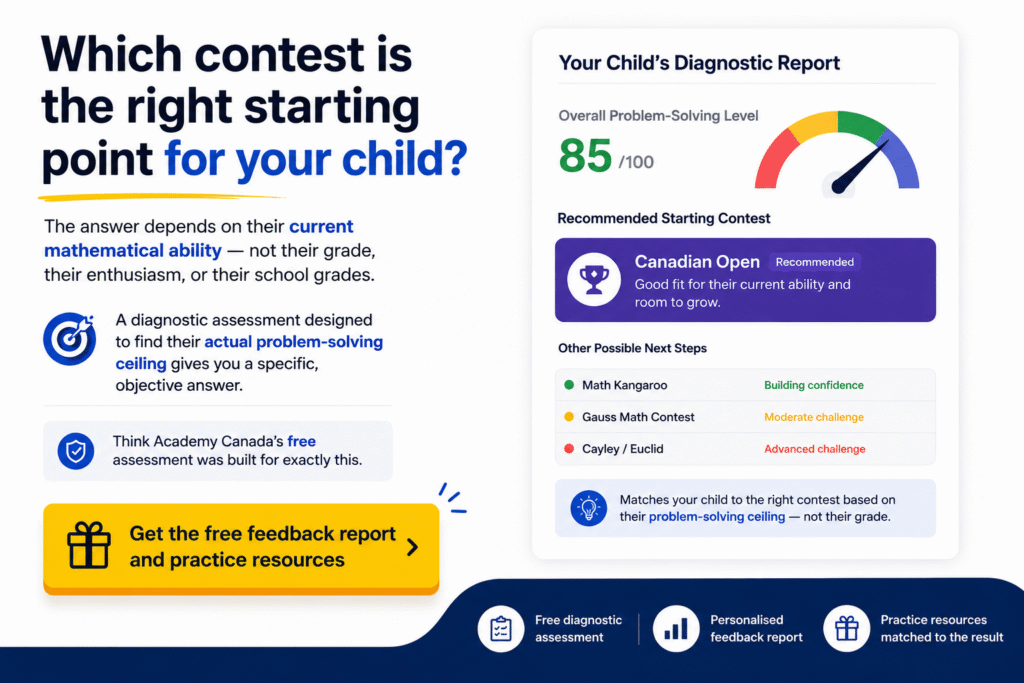
Our approach starts with a free diagnostic. Every new student completes a short assessment and receives a personalised feedback report showing exactly where their mathematical problem-solving ability currently sits. For families choosing a starting competition, this gives you a specific, objective answer: not which contest a student’s grade suggests, but which contest level their current ability actually matches.
From there, our structured preparation programmes build the specific skills competition problems reward — number theory, combinatorics, non-routine geometry, and algebraic reasoning — none of which appear adequately in school curricula, and all of which respond well to dedicated practice.

FAQs
What math competitions are available to Canadian students?
The two main pathways are the CEMC series (University of Waterloo: Gauss, Pascal, Cayley, Fermat, Euclid) and the AMC series (AMC 8, AMC 10, AMC 12, AIME). Both are available to Canadian students and test mathematical reasoning rather than curriculum recall.
What is the best math competition for a Grade 7 or 8 student in Canada?
The CEMC Gauss Contest is the most widely sat entry-level competition and the natural starting point. The AMC 8 is also an excellent option for students in Grade 8 and below, particularly for those with ambitions at US or international universities.
What math competition should a Grade 9 or 10 student enter?
Grade 9 students typically write the CEMC Pascal Contest (February) and may also write the AMC 10 (November). Grade 10 students write the CEMC Cayley Contest (February) and may write AMC 10 (November). Strong students often do both series concurrently.
How do Canadian math competitions help with university admissions?
The CEMC Euclid Contest (Grade 12) is directly considered by the University of Waterloo in admissions and scholarship decisions for mathematics, computer science, and engineering. AMC performance and AIME qualification are recognised by US and international universities. Both carry significantly more weight as admissions credentials than school extracurriculars.
When do Canadian math competitions take place in 2026/27?
AMC 10/12: November 5 and 13, 2026. AMC 8: January 21–27, 2027. CEMC Pascal/Cayley/Fermat: February 2027. CEMC Euclid: April 2027. CEMC Gauss: May 2027. CEMC registration opens September 2026.
How do I register my child for a math competition in Canada?
For CEMC contests, students register through their school — ask the math teacher or department head. Registration opens September 2026 for the 2026/27 cycle. For AMC contests, schools register through the MAA. If a school doesn’t participate, students can look for another local school or registered centre.
What is the difference between the CEMC and AMC pathways?
The CEMC pathway is organised by the University of Waterloo and is more directly recognised by Canadian universities. The AMC pathway is organised by the Mathematical Association of America and leads to AIME qualification, carrying more weight with US and international universities. Strong Canadian students often participate in both.
How hard are Canadian math competitions?
Competition math is deliberately harder than school curriculum — it tests flexible reasoning and problem-solving rather than procedure following. The early questions on Gauss or AMC 8 are accessible for a well-prepared student. The hardest questions are designed to challenge the strongest students in the country. Specific preparation for competition problem types makes a significant difference.
At what age should a child start math competition preparation?
There is no fixed answer — it depends on the individual student’s ability. Many strong students begin with the CEMC Gauss or AMC 8 in Grade 7 or 8. Starting earlier gives more time to develop the problem-solving foundations that the harder contests reward. A diagnostic assessment is the most reliable way to identify the right starting point.
Does Think Academy Canada offer competition math preparation?
Yes. Think Academy Canada offers preparation for the full CEMC contest series (Gauss through Euclid) and the AMC series (AMC 8, AMC 10, AMC 12), working exclusively with motivated, high-performing students. A free diagnostic assessment identifies the right starting level for every new student.
About Think Academy Canada Think Academy Canada is a K-12 mathematics tutoring programme, part of TAL Education Group. We work exclusively with motivated, high-performing students across Canada from Grade 1 through Grade 12, with a focus on competition mathematics including the CEMC series and AMC. All lessons are delivered online. Follow us on Instagram at @thinkacademyca.

