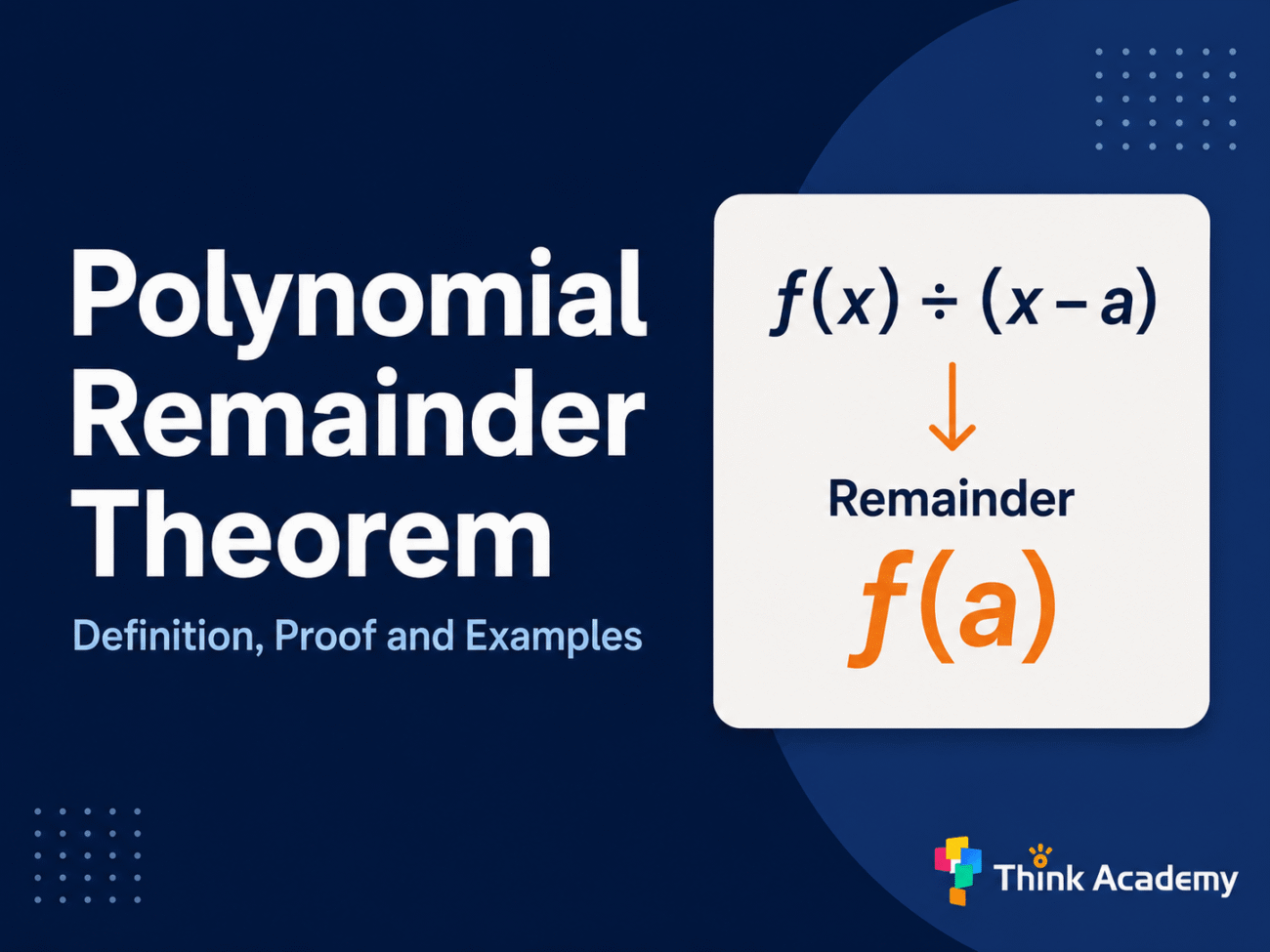
The polynomial remainder theorem is one of the most elegant shortcuts in algebra. Instead of performing polynomial long division to find the remainder, the theorem lets you find it by evaluating the polynomial at a single point. It is a prerequisite for the Factor Theorem, a foundational tool in MCR3U Unit 2, and appears in both curriculum assessments and mathematics competitions. This guide explains the theorem, proves it, walks through worked examples, and connects it to the broader polynomial toolkit.
A small sign error can turn a straightforward remainder question into lost marks. Our free math assessment identifies how confidently your child applies polynomial concepts—and where they may need more support before their next test.
Start the free math assessment →
What Is the Polynomial Remainder Theorem?
The polynomial remainder theorem states:
When a polynomial f(x) is divided by a linear divisor (x − a), the remainder is equal to f(a).f(x)=(x−a)⋅q(x)+r
where q(x) is the quotient polynomial and r is the remainder. Substituting x = a:f(a)=(a−a)⋅q(a)+r=0⋅q(a)+r=r
So r = f(a) — the remainder is simply the value of the polynomial at x = a.
In plain English: to find the remainder when f(x) is divided by (x − a), substitute x = a directly into f(x). No long division required.
Proof of the Polynomial Remainder Theorem
The proof is short and relies only on the definition of polynomial division.
Claim: When f(x) is divided by (x − a), the remainder is f(a).
Proof:
By the division algorithm for polynomials, we can always write:f(x)=(x−a)⋅q(x)+r
where q(x) is a polynomial (the quotient) and r is a constant (the remainder, since the divisor is linear and of degree 1, the remainder has degree less than 1 — so it is a constant).
Substitute x = a:f(a)=(a−a)⋅q(a)+r=0+r=r
Therefore r = f(a). □
This proof is short enough to reproduce from memory — and knowing it makes the theorem feel logical rather than arbitrary.
The Polynomial Remainder Theorem vs The Factor Theorem
These two theorems are closely related. Understanding the distinction is essential for MCR3U.
| Polynomial Remainder Theorem | Factor Theorem | |
|---|---|---|
| What it says | The remainder when f(x) is divided by (x − a) is f(a) | (x − a) is a factor of f(x) if and only if f(a) = 0 |
| When remainder = 0 | f(a) = 0 | (x − a) divides f(x) exactly |
| Relationship | General case | Special case where remainder = 0 |
The Factor Theorem is a special case of the polynomial remainder theorem.
If f(a) = 0 (remainder is zero), then (x − a) is a factor — division leaves no remainder. This is the Factor Theorem.
If f(a) ≠ 0, the polynomial remainder theorem gives you the exact remainder without division.
Worked Examples
Example 1 — Finding a Remainder (MCR3U Level)
Find the remainder when f(x) = x³ − 4x² + 3x − 7 is divided by (x − 2).
By the polynomial remainder theorem: remainder = f(2)
f(2) = (2)³ − 4(2)² + 3(2) − 7 = 8 − 16 + 6 − 7 = −9
The remainder is −9. No long division required.
Verify with long division (optional):
x³ − 4x² + 3x − 7 ÷ (x − 2) = x² − 2x − 1 with remainder −9 ✓
Example 2 — Divisor of the Form (x + a)
Find the remainder when f(x) = 2x³ + x² − 5x + 1 is divided by (x + 3).
Write (x + 3) = (x − (−3)), so a = −3.
Remainder = f(−3):
f(−3) = 2(−3)³ + (−3)² − 5(−3) + 1 = 2(−27) + 9 + 15 + 1 = −54 + 25 = −29
The remainder is −29.
Example 3 — Divisor (ax − b): Extension
Find the remainder when f(x) = 3x³ − x² + 2x − 4 is divided by (3x − 1).
Write 3x − 1 = 3(x − 1/3), so set x = 1/3.
Remainder = f(1/3):
f(1/3) = 3(1/3)³ − (1/3)² + 2(1/3) − 4 = 3(1/27) − 1/9 + 2/3 − 4 = 1/9 − 1/9 + 2/3 − 4 = 2/3 − 4 = −10/3
Note: When dividing by a non-monic linear divisor (ax − b), the remainder is still f(b/a). The quotient changes, but the remainder from the polynomial remainder theorem is the same.
Example 4 — Working Backwards: Finding an Unknown Coefficient
The polynomial f(x) = x³ + kx² − 2x + 5 has remainder 11 when divided by (x − 2). Find k.
By the polynomial remainder theorem: f(2) = 11
f(2) = (2)³ + k(2)² − 2(2) + 5 = 8 + 4k − 4 + 5 = 9 + 4k
Set equal to 11: 9 + 4k = 11 4k = 2 k = 1/2
This type of problem — finding a coefficient from a given remainder — is a standard MCR3U exam question type and appears regularly in MHF4U assessments.
Example 5 — Two Conditions, System of Equations (MHF4U Level)
The polynomial f(x) = x³ + ax² + bx − 3 has remainder 5 when divided by (x − 2) and remainder −7 when divided by (x + 1). Find a and b.
From (x − 2): f(2) = 5 8 + 4a + 2b − 3 = 5 4a + 2b = 0 2a + b = 0 … (1)
From (x + 1): f(−1) = −7 −1 + a − b − 3 = −7 a − b = −3 a − b = −3 … (2)
Add (1) and (2): 3a = −3 → a = −1
Substitute into (1): 2(−1) + b = 0 → b = 2
f(x) = x³ − x² + 2x − 3
Verify: f(2) = 8 − 4 + 4 − 3 = 5 ✓ and f(−1) = −1 − 1 − 2 − 3 = −7 ✓
This two-condition system is the most algebraically demanding polynomial remainder theorem problem type at the MCR3U/MHF4U level.

Example 6 — Connecting to the Factor Theorem
Determine whether (x − 3) is a factor of f(x) = x³ − 2x² − 5x + 6.
By the polynomial remainder theorem: f(3) = (3)³ − 2(3)² − 5(3) + 6 = 27 − 18 − 15 + 6 = 0
Since f(3) = 0, the remainder is 0, so (x − 3) is a factor of f(x).
Factor: f(x) ÷ (x − 3) = x² + x − 2 = (x + 2)(x − 1)
f(x) = (x − 3)(x + 2)(x − 1)
Where the Polynomial Remainder Theorem Appears in Contests and Curriculum
MCR3U (Unit 2: Polynomial Functions): The polynomial remainder theorem is explicitly taught and assessed in Ontario’s Grade 11 curriculum. Unit tests and final exams include direct remainder calculations (Examples 1–2), working backwards to find a coefficient (Example 4), and combined use with the Factor Theorem (Example 6). Students who can apply the theorem quickly — finding f(a) by substitution rather than long division — complete polynomial questions significantly faster. See our MCR3U complete guide.
MHF4U (Polynomial and Rational Functions Unit): MHF4U builds on the polynomial remainder theorem with higher-degree polynomials, more complex coefficient-finding problems, and the two-condition system type (Example 5). Students are expected to apply the theorem fluently without re-deriving it. See our MHF4U Advanced Functions guide.
Euclid Contest (CEMC, Grade 12): Polynomial algebra appears regularly in Euclid Part B — typically in the form of a multi-step problem where the polynomial remainder theorem is one tool among several (combined with the rational root theorem, the Factor Theorem, or system-solving). A student who is slow at applying the theorem by hand will lose time on these problems. See our Euclid math contest guide.
AMC 10 and Cayley Contest: Polynomial problems at the AMC 10 and Cayley level occasionally involve remainder-type questions, particularly asking for the remainder when a polynomial is evaluated at a specific value. Knowing the polynomial remainder theorem allows direct evaluation where other students attempt full division. See our Cayley math contest guide.
For the full competition landscape, see our math competitions in Canada guide.
The Polynomial Remainder Theorem and Synthetic Division
Synthetic division and the polynomial remainder theorem are complementary tools:
- The polynomial remainder theorem gives the remainder instantly via substitution — f(a) — without any division
- Synthetic division performs the actual division and yields both the quotient polynomial and the remainder simultaneously
When you only need the remainder, use the polynomial remainder theorem — it is faster.
When you need both the remainder and the quotient (e.g., to continue factoring), use synthetic division — which also confirms the remainder as its final entry.
Example: f(x) = x³ − 4x² + 3x − 7 divided by (x − 2)
Polynomial remainder theorem: f(2) = 8 − 16 + 6 − 7 = −9. Done.
Synthetic division gives: quotient x² − 2x − 1, remainder −9.
Both confirm the remainder is −9. For factoring purposes, synthetic division is needed for the quotient. For a remainder-only question, the polynomial remainder theorem is the efficient choice.
Common Mistakes
Mistake 1: Substituting the wrong value. When dividing by (x − a), substitute x = +a (not −a). When dividing by (x + 3) = (x − (−3)), substitute x = −3. Students who substitute the wrong sign get the wrong remainder every time.
Mistake 2: Confusing the remainder with the quotient. The polynomial remainder theorem gives the remainder — the constant left over. It does not give the quotient polynomial. If the question asks for the quotient, synthetic division is required.
Mistake 3: Using the theorem with non-linear divisors. The theorem applies to division by linear factors (x − a) only. Dividing by x² − 1 or any non-linear expression requires full polynomial long division.
Mistake 4: Arithmetic errors in evaluating f(a). The calculation of f(a) — especially for cubic and quartic polynomials with multiple terms — is where most errors occur. Write each term substitution on a separate line; do not try to compute f(a) in one mental step.
Mistake 5: Thinking remainder = 0 means the theorem doesn’t apply. If f(a) = 0, the remainder is simply 0 — the polynomial remainder theorem applies as always. The consequence (that (x − a) is a factor) is the Factor Theorem, which follows directly from the polynomial remainder theorem.
Practice Problems
Set A — Direct application
Find the remainder when f(x) is divided by the given divisor:
- f(x) = x³ + 2x² − x + 4, divided by (x − 3)
- f(x) = 2x³ − 5x + 1, divided by (x + 2)
- f(x) = x⁴ − 3x³ + x − 5, divided by (x − 1)
- f(x) = 3x³ + x² − 7x + 2, divided by (x + 1)
- f(x) = x³ − 8, divided by (x − 2)
- f(x) = 5x⁴ − 2x³ + x − 3, divided by (x + 1)
Set B — Working backwards
- f(x) = x³ + kx² + 3x − 5 has remainder 3 when divided by (x − 2). Find k.
- f(x) = 2x³ − 3x² + mx + 4 has remainder −1 when divided by (x + 1). Find m.
- f(x) = x³ + ax + b has remainder 4 when divided by (x − 1) and remainder −2 when divided by (x + 1). Find a and b.
Set C — Connecting to the Factor Theorem
- Determine whether (x + 2) is a factor of f(x) = x³ + x² − 4x − 4.
- For what value of k is (x − 3) a factor of f(x) = x³ − kx² + 2x − 3?
- f(x) = x³ + 2x² − 5x + k. Find k so that (x − 1) is a factor, then fully factor f(x).
Answers:
Set A:
- f(3) = 27 + 18 − 3 + 4 = 46
- f(−2) = −16 + 10 + 1 = −5
- f(1) = 1 − 3 + 1 − 5 = −6
- f(−1) = −3 + 1 + 7 + 2 = 7
- f(2) = 8 − 8 = 0 (so (x−2) is a factor — f(x) = (x−2)(x²+2x+4))
- f(−1) = 5 + 2 − 1 − 3 = 3
Set B: 7) f(2) = 8 + 4k + 6 − 5 = 9 + 4k = 3 → 4k = −6 → k = −3/2 8) f(−1) = −2 − 3 − m + 4 = −1 − m = −1 → m = 0 9) f(1) = 1 + a + b = 4 → a + b = 3 … (1); f(−1) = −1 − a + b = −2 → −a + b = −1 … (2); Add: 2b = 2 → b = 1; then a = 2. a = 2, b = 1
Set C: 10) f(−2) = −8 + 4 + 8 − 4 = 0 ✓. Yes, (x+2) is a factor. f(x) = (x+2)(x²−x−2) = (x+2)(x−2)(x+1) 11) f(3) = 0: 27 − 9k + 6 − 3 = 0 → 30 − 9k = 0 → k = 10/3 12) f(1) = 0: 1 + 2 − 5 + k = 0 → k = 2. f(x) = x³ + 2x² − 5x + 2. Divide by (x−1): quotient x² + 3x − 2. Discriminant = 9 + 8 = 17 — does not factor over integers. f(x) = (x−1)(x² + 3x − 2). (Quadratic factor is irreducible over integers.)
Frequently Asked Questions
What is the polynomial remainder theorem? When a polynomial f(x) is divided by a linear factor (x − a), the remainder is f(a). This allows the remainder to be found by direct substitution rather than polynomial long division.
What is the difference between the polynomial remainder theorem and the Factor Theorem? The polynomial remainder theorem gives the remainder for any division by (x − a). The Factor Theorem is the special case where the remainder is zero — meaning (x − a) divides f(x) exactly and is therefore a factor. Every application of the Factor Theorem is an application of the polynomial remainder theorem with result zero.
Does the polynomial remainder theorem work for non-linear divisors? No. The theorem applies only when dividing by a linear expression (x − a). For non-linear divisors, polynomial long division is required and the remainder is a polynomial, not a constant.
How is the polynomial remainder theorem used to find unknown coefficients? If the remainder of f(x) ÷ (x − a) is known, set f(a) equal to that remainder value and solve for the unknown coefficient. This produces one equation per condition — two unknowns require two conditions and a system of equations (as in Example 5).
Is the polynomial remainder theorem on the MCR3U exam? Yes. It is explicitly part of the Ontario Grade 11 curriculum (Unit 2: Polynomial Functions) and is assessed on unit tests and final exams. The most commonly tested forms are direct remainder calculation and working backwards to find an unknown coefficient.
What is the easiest way to remember the theorem? “Divide by (x − a), remainder is f(a).” The value that makes the divisor zero — x = a — is exactly the value you substitute into f(x) to get the remainder.
See our related guides: rational root theorem guide · MCR3U complete guide · MHF4U Advanced Functions guide · types of function in math guide · composite functions maths guide · Euclid math contest guide · Cayley math contest guide · math induction proof guide · math competitions in Canada
The polynomial remainder theorem is a one-line shortcut with exam marks attached. Make sure your child can use it cold.