


Grade 4 is where Ontario math starts getting serious. Multiplication tables become a daily requirement. Fractions appear for the first time. Multi-digit operations get longer. And — most importantly for ambitious parents — Grade 4 is where the difference between strong math students and average ones becomes visible. The grade 4 math curriculum in Ontario, based on the 2020 elementary curriculum framework, covers six distinct strands: Number, Algebra, Data, Spatial Sense, Financial Literacy, and Mathematical Processes. This guide walks Canadian parents through everything taught in Grade 4 math, which topics matter most, what “ahead of curriculum” actually looks like at this age, and how to support your child’s math development at home — whether they’re meeting expectations or aiming significantly higher.
What is the Grade 4 math curriculum in Ontario?
The Grade 4 math curriculum in Ontario is part of the 2020 elementary mathematics curriculum framework, which replaced the previous 2005 curriculum in September 2020. The 2020 curriculum brought significant changes — most notably the introduction of coding as a math topic, a stronger focus on financial literacy, and an emphasis on spatial reasoning across all grades.
The curriculum is published by the Ontario Ministry of Education and applies to all publicly funded schools in Ontario. Independent and private schools may use different curricula, but the majority follow the Ontario standards. The full official curriculum document is available at ontario.ca.
Why Grade 4 matters
Grade 4 is a pivotal year in a Canadian student’s math journey for three reasons:
It’s the year where math becomes genuinely abstract. Grades 1-3 cover concrete operations students can largely visualise. Grade 4 introduces fractions, multi-step word problems, and area concepts that require real abstract reasoning.
It’s the year where ability differences become visible. In Grades 1-3, most students stay roughly together. By Grade 4, the gap between strong students and the rest of the class becomes obvious — both to the child and to the parents.
It’s the year that determines later trajectory. Students who are confident with multiplication, fractions, and basic problem-solving in Grade 4 typically maintain that confidence through Grades 5-8 and beyond. Students who fall behind in Grade 4 often struggle for years afterward.
For ambitious parents, Grade 4 is when serious math enrichment becomes worth considering — early enough to build deep foundations, late enough that the material is substantive.
The six strands of the Grade 4 math curriculum
The Ontario 2020 curriculum organises math into six strands. Each strand has specific expectations at each grade level.
Strand A — Social-Emotional Learning Skills and Mathematical Processes
This strand isn’t a “topic” but rather a set of skills woven throughout all the other strands. It covers:
- Problem-solving strategies
- Reasoning and proving mathematical claims
- Reflecting on solutions
- Connecting math to real-world situations
- Communicating mathematical thinking clearly
- Representing math in multiple ways (visual, symbolic, verbal)
These process skills matter as much as content knowledge for strong long-term math development. A Grade 4 student who can articulate why an answer is correct typically goes further in math than one who can only produce correct answers without understanding.
Strand B — Number
This is the largest and most heavily weighted strand at Grade 4. Topics include:
Number Sense (B1):
- Whole numbers up to 10,000 (reading, writing, comparing, ordering)
- Place value to the ten-thousands
- Composing and decomposing numbers
- Fractions: introducing halves, thirds, quarters, fifths, sixths, eighths, and tenths
- Equivalent fractions
- Reading and representing decimal tenths and hundredths
- Comparing and ordering fractions and decimals
Operations (B2):
- Multiplication facts to 12 × 12 (this is the major Grade 4 milestone — the Ministry explicitly calls this out as a foundational skill)
- Related division facts
- Multi-digit addition and subtraction (up to 4-digit numbers)
- Two-digit by one-digit multiplication
- Three-digit by one-digit multiplication
- Division with one-digit divisors
- Estimation strategies
The expectation that students master multiplication facts up to 12 × 12 is a meaningful jump from earlier grades. Strong Grade 4 students should know these facts cold by mid-year. Students who don’t have fact fluency by end of Grade 4 typically struggle with the Grade 5 curriculum, which assumes this fluency.
Strand C — Algebra
The Algebra strand has three sub-strands at Grade 4:
C1 — Patterns and Relationships:
- Identifying and extending increasing and decreasing patterns
- Patterns using all four operations
- Translating between visual, symbolic, and verbal representations of patterns
C2 — Equations and Inequalities:
- Solving simple equations using inverse operations
- Working with variables (using letters and symbols to represent unknown quantities)
- Understanding equality
C3 — Coding:
- Writing simple code (sequential, concurrent, and repeating events)
- Using code to investigate mathematical concepts
- Reading and altering code
The introduction of coding in Grade 4 was one of the most significant changes in the 2020 curriculum. Students learn to use simple coding to investigate math concepts (e.g., using loops to generate patterns). This isn’t traditional computer programming — it’s structured logical thinking.
Strand D — Data
Topics include:
- Collecting data through surveys and experiments
- Organising data using tally charts, frequency tables, and stem-and-leaf plots
- Reading and creating bar graphs, pictographs, and broken-line graphs (yes, broken-line graphs appear here — the same concept tested on AMC 8)
- Understanding mean as a measure of central tendency
- Calculating mean for simple data sets
- Describing the likelihood of events using probability vocabulary
- Comparing experimental and theoretical probability
Strand E — Spatial Sense
The Spatial Sense strand covers geometry and measurement. Grade 4 topics include:
Geometry:
- Identifying and constructing 2D shapes by attributes
- Identifying types of triangles (equilateral, isosceles, scalene)
- Understanding angle properties
- Constructing shapes with specified properties
- Recognising and creating tessellations
- Identifying lines of symmetry
Measurement:
- Measuring length using millimetres, centimetres, metres, and kilometres
- Converting between metric units
- Calculating perimeter of polygons
- Calculating area of rectangles
- Measuring mass and capacity
- Reading time on analog and digital clocks (including 24-hour clock)
- Calculating elapsed time
The Spatial Sense strand has grown in emphasis under the 2020 curriculum, with explicit recognition that spatial reasoning is foundational for later math (algebra, geometry, calculus all rely on spatial thinking).
Strand F — Financial Literacy
Grade 4 financial literacy topics include:
- Identifying Canadian coins and bills
- Calculating totals and making change
- Understanding the concepts of saving and spending
- Distinguishing between needs and wants
- Basic understanding of how money is earned, saved, and spent
Financial literacy was significantly expanded in the 2020 curriculum and is now a required strand at every grade. The expectations at Grade 4 are relatively basic; they become more sophisticated in later grades.
The biggest Grade 4 math milestones
Across all six strands, a few topics matter disproportionately. Mastering these in Grade 4 sets up everything that follows.
Mastering multiplication facts
The Ministry explicitly identifies “learning multiplication facts of 0 × 0 to 12 × 12” as a foundational skill at this level. This isn’t optional. Students who don’t have these facts cold by end of Grade 4:
- Struggle with multi-digit multiplication (which assumes fact fluency)
- Struggle with division (which is the inverse of multiplication)
- Struggle with fractions (which require understanding factors and multiples)
- Struggle with everything from Grade 5 onwards
If your child doesn’t know their multiplication facts by mid-Grade 4, this is the single most important thing to address. Daily 5-10 minute practice with flashcards, multiplication games, or apps closes the gap surprisingly fast.
Understanding fractions
Grade 4 is the first year fractions appear as a meaningful topic. The expectations include:
- Recognising fractions as parts of a whole
- Comparing fractions with the same denominator
- Identifying equivalent fractions
- Representing fractions on number lines
Fractions are conceptually difficult for most children — they’re the first abstract math concept that doesn’t follow the rules of whole numbers. Students who genuinely understand fractions in Grade 4 (not just memorise procedures) have a major advantage in Grades 5-8 where fractions become much more complex.
For deeper coverage of fraction work appropriate for Grade 4 and beyond, see our fractions to decimals guide for parents.
Multi-step problem solving
Grade 4 is where word problems get genuinely multi-step. A typical problem might require:
- Reading and identifying the question
- Identifying which operations to use
- Performing the operations in the correct order
- Checking whether the answer makes sense
Students who can do all four steps consistently are well-prepared for Grade 5 and beyond. Students who can do the arithmetic but stumble on the reading and reasoning need to focus on problem-solving strategy as much as content.
How does Grade 4 math compare to other provinces?
Most Canadian provinces cover similar Grade 4 math content, but with different curriculum structures.
Grade 4 math across Canada
| Province | Curriculum framework | Key differences from Ontario |
|---|---|---|
| Ontario | 2020 elementary math curriculum | Most explicit coding emphasis; structured six-strand approach |
| British Columbia | BC mathematics curriculum | Similar content with different organisation |
| Alberta | Alberta Programs of Study | More traditional structure; less coding emphasis |
| Quebec | Quebec Education Program | Different terminology but comparable content |
| Atlantic provinces | Atlantic Canada Mathematics Curriculum | Similar content, less subject-specific |
The actual math content is largely consistent across Canadian provinces by Grade 4. Children moving between provinces should have minimal curriculum disruption at this age.
If you’re specifically researching the BC curriculum, see resources at the BC Ministry of Education. Similar patterns hold across other provinces.
How to know if your Grade 4 child is on track
Most parents struggle to evaluate where their child genuinely stands. Three indicators matter most.
The report card
Ontario uses a four-level achievement scale aligned with EQAO levels:
| Level | Description | Approximate percentage |
|---|---|---|
| Level 4 | Surpasses provincial standard | 80%+ |
| Level 3 | Meets provincial standard | 70-79% |
| Level 2 | Approaching provincial standard | 60-69% |
| Level 1 | Below provincial standard | 50-59% |
Level 3 is “meets the standard” but is not “ahead” — it just means your child is at expected level. Strong Grade 4 students should be at Level 4 in math. Students at Level 2 or below need attention.
The multiplication fact test
Try this at home: ask your child these 10 multiplication facts in random order, with a 5-second time limit each:
- 7 × 8
- 6 × 9
- 8 × 7
- 4 × 9
- 11 × 11
- 6 × 8
- 9 × 7
- 12 × 6
- 8 × 8
- 7 × 9
A confident Grade 4 student should answer all 10 correctly within the time limit. Hesitation or errors on 3+ indicates incomplete fact fluency — a real risk for Grade 5 and beyond.
The word problem test
Give your child this problem (without help):
Maya bought 4 packs of stickers. Each pack contained 25 stickers. She gave 17 stickers to her sister and 23 stickers to her brother. How many stickers does Maya have left?
A confident Grade 4 student should:
- Identify that they need to multiply 4 × 25 first (= 100)
- Identify that they need to subtract 17 + 23 = 40 from the total
- Calculate 100 − 40 = 60
- Recognise that 60 is a reasonable answer
If your child struggles with any of these steps — including identifying which operations to use — they need work on multi-step problem solving, not just arithmetic.
How to support your Grade 4 child at home
The math your child does outside school matters more in Grade 4 than at any prior age. A few high-leverage habits:
Build multiplication fact fluency relentlessly
This is the single highest-leverage activity for Grade 4. Five to ten minutes a day of multiplication practice — flashcards, apps, games, drill sheets — produces dramatic results in 4-6 weeks. Once facts are fluent, every other Grade 4 topic becomes easier.
Tools that work:
- Physical flashcards (still effective despite being old-school)
- Free apps (Times Tables Rock Stars, Multiplication.com, Math Drills)
- Memorisation through songs/chants (works particularly well for kinesthetic learners)
- “Random fact” practice during car rides or meal preparation
Read math problems out loud together
Multi-step word problems are where Grade 4 students most often fail. Sitting with your child while they read problems aloud — and asking “what is the question asking?” before they start calculating — builds the problem-solving strategy school doesn’t always teach.
Use real-world math constantly
Grade 4 math becomes more sticky when it’s applied. Examples:
- Calculate the total cost while grocery shopping
- Estimate how much change you’ll get
- Read recipes and measure ingredients (including converting units)
- Calculate elapsed time when planning activities (“if dinner is at 6 and it takes 45 minutes to cook, when should we start?”)
- Calculate area when arranging furniture or planning crafts
Don’t help with homework problems
Counterintuitive but important. When your child gets stuck, ask questions rather than provide answers:
- “What is the question asking?”
- “What do you already know?”
- “What’s one thing you could try?”
- “Can you draw a picture of the problem?”
Students who have parents who explain how to do every problem don’t develop independent problem-solving. They learn to wait for help. Students whose parents ask guiding questions learn to work through difficulty independently — a skill that matters far beyond Grade 4.
Consider a structured enrichment program
For high-performing Grade 4 students, school math is often too slow. The curriculum is designed for the median student, not the top 20%. Strong students who only do school math frequently coast through Grades 4-6 and then hit a wall in Grade 7 or 8 when content becomes more demanding.
Structured enrichment — whether through a tutoring program, a math contest pathway, or advanced workbooks — keeps strong students genuinely challenged and builds the foundations they’ll need later.
What comes after Grade 4?
Grade 4 builds the foundation for everything that follows in Canadian elementary math.
Grade 5 builds on Grade 4
By Grade 5, students need:
- Fluent multiplication and division up to 12 × 12 (still!)
- Confident multi-digit operations
- Understanding of fractions (with new emphasis on operations)
- Stronger problem-solving strategies
Students weak in Grade 4 fundamentals typically struggle disproportionately in Grade 5.
The path to Grade 6 EQAO
Grade 6 brings the second EQAO assessment of your child’s school career. The content tested at Grade 6 builds directly on Grade 4 foundations:
- Number operations (now with larger numbers and decimals)
- Fractions (with operations)
- Measurement and geometry (more complex shapes and applications)
- Data and probability (more sophisticated analysis)
Strong Grade 4 students typically score Level 3 or 4 on the Grade 6 EQAO. Students who struggled in Grade 4 typically score Level 2 or below.
For details on the Grade 6 EQAO, see our complete Grade 6 EQAO guide and our Grade 6 math curriculum guide.
Early contest mathematics
For ambitious Grade 4 students, this is the right age to start exploring contest mathematics. Specifically:
- Math Kangaroo (Grades 1-12, but very popular for Grades 3-5) — the ideal first contest, with low pressure and accessible problems. See our Math Kangaroo Canada complete guide.
- Building foundations for Gauss (Grade 7-8) — strong Grade 4 students start building the problem-solving skills that distinguish Gauss winners 3-4 years before they actually compete
For a broader look at the Canadian math contest pipeline, see our Waterloo math competitions guide and our AMC 8 guide.
How Think Academy Canada supports Grade 4 students
Think Academy is the international arm of TAL Education Group, one of the largest education companies in the world. Our Canadian programs are designed for high-performing students ready to engage with material that runs ahead of the standard curriculum.
Curriculum that runs ahead of the Ontario standard. Our Grade 4 students typically work with Grade 5 content while their classmates are still on Grade 4 material. This isn’t “ahead just for the sake of it” — it’s how strong students prevent the boredom and disengagement that often comes from school math being too slow.
Focus on multiplication fluency, fractions, and problem-solving. Our Grade 4 program prioritises the three areas that most determine later math success: fact fluency, conceptual understanding of fractions, and multi-step problem-solving strategy.
Contest preparation woven into the curriculum. Our Grade 4 students get exposure to Math Kangaroo-style problems throughout the year, building the kind of creative thinking that distinguishes contest winners.
Teachers who mark every homework set personally. Real feedback on the types of mistakes your child is making — far more valuable than auto-graded “correct/incorrect” feedback at this age.
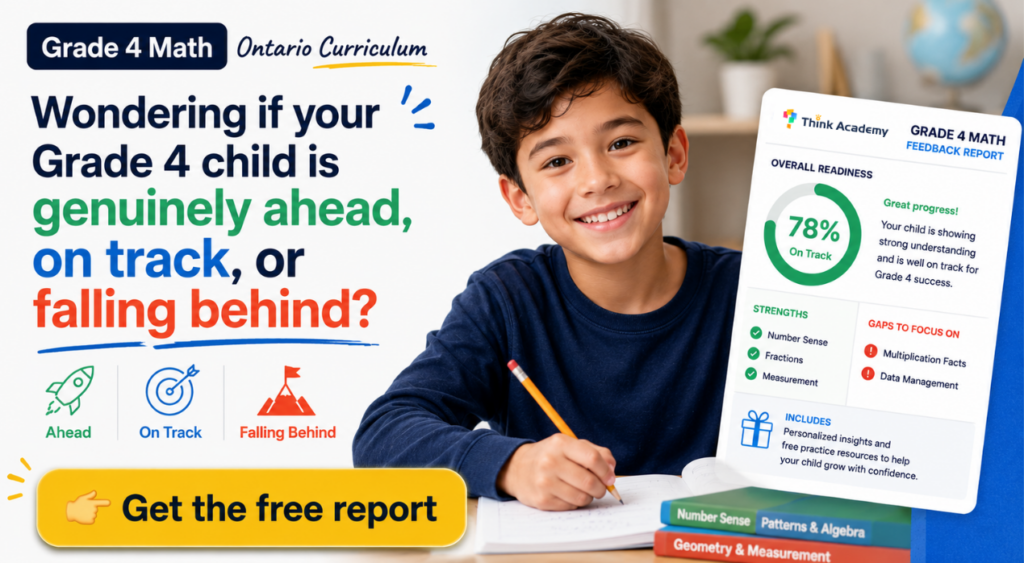
Free math assessment. Find out exactly where your Grade 4 child stands. Our free assessment takes about 20 minutes, gives you a detailed feedback report on strengths and gaps by topic, and includes free practice resources tailored to your child’s level.
Frequently asked questions
What is taught in Grade 4 math in Ontario?
The Ontario Grade 4 math curriculum covers six strands: Number (including multiplication facts to 12×12 and introduction to fractions), Algebra (patterns, equations, coding), Data (graphs, mean, probability), Spatial Sense (geometry and measurement), Financial Literacy (money and saving), and Mathematical Processes (problem-solving). The 2020 curriculum is the current framework.
What math facts should a Grade 4 student know?
Multiplication facts from 0×0 to 12×12 and their related division facts. The Ontario Ministry explicitly identifies this as a foundational Grade 4 skill. Students should know these facts cold (within 5 seconds) by mid-Grade 4.
Is Grade 4 math hard?
It’s the year math becomes meaningfully harder than earlier grades. Multiplication facts, fractions, multi-step word problems, and area calculations all enter the curriculum. Students who were strong in Grades 1-3 sometimes struggle in Grade 4 when content becomes more abstract.
How is Grade 4 math marked in Ontario?
Ontario uses a four-level achievement scale: Level 4 (surpasses standard, 80%+), Level 3 (meets standard, 70-79%), Level 2 (approaching standard, 60-69%), Level 1 (below standard, 50-59%). Level 3 is “meets expectations” — strong students should target Level 4.
What’s the difference between the 2005 and 2020 Ontario math curriculum?
The 2020 curriculum (current) added coding as a math topic, expanded financial literacy, emphasised spatial reasoning, and reorganised the strand structure. The 2005 curriculum was replaced in September 2020.
What is the most important Grade 4 math skill?
Multiplication fact fluency (0×0 through 12×12 plus related division facts). Students without this fluency by end of Grade 4 typically struggle with all subsequent math content.
How can I tell if my Grade 4 child is ahead in math?
Three indicators: (1) consistent Level 4 marks on math report cards, (2) fluent multiplication facts to 12×12, and (3) ability to solve multi-step word problems independently. A student strong in all three is genuinely ahead.
How can I help my Grade 4 child with math at home?
Build multiplication fact fluency through daily 5-10 minute practice, do real-world math (cooking, shopping, time estimates), read word problems together asking what the question is asking, and use guiding questions rather than providing answers when they’re stuck.
Are there Grade 4 math worksheets?
Many free and paid resources publish Grade 4 math worksheets. Free options include Khan Academy Canada, the Ontario Ministry’s released items, and various educational websites. Quality and curriculum alignment vary — check that materials match the current 2020 Ontario curriculum.
Is there an EQAO in Grade 4?
No. EQAO is administered in Grades 3, 6, and 9 (and the Grade 10 OSSLT for literacy). There’s no EQAO at Grade 4.
How does Grade 4 math curriculum differ in BC, Alberta, and other provinces?
Content is largely similar across Canadian provinces by Grade 4. Ontario has the strongest coding integration and most explicit six-strand framework. BC and Alberta organise content differently but cover roughly the same skills. Students moving between provinces typically face minimal Grade 4 disruption.
What is coding in Grade 4 math?
Coding in the Ontario Grade 4 curriculum means writing simple programs (sequential, concurrent, and repeating events) to investigate math concepts — for example, using loops to generate patterns. It’s structured logical thinking applied to math, not traditional computer programming.
When should my Grade 4 child start math contests?
Math Kangaroo (Grades 1-12, but particularly popular for Grades 3-5) is the ideal first contest at Grade 4. It’s accessible, fun, and builds the kind of creative thinking that distinguishes ambitious math students. Stronger Grade 4 students can also begin building foundations for Gauss (Grade 7-8) and AMC 8 (Grades 6-8) through enrichment programs.
Is my Grade 4 child ready for math enrichment?
If your child is consistently at Level 4 on math report cards, fluent with multiplication facts, and finishes school math quickly while wanting more challenge, they’re likely ready for enrichment. Many ambitious Grade 4 students benefit significantly from structured enrichment that runs ahead of the school curriculum.
About Think Academy Canada
Think Academy Canada, part of TAL Education Group, supports K–12 students with structured math programs built around an online interactive platform, gamified learning, and teachers who personally mark every homework set. Our curriculum runs ahead of the provincial standards and is designed to prepare high-performing students for both school excellence and competitive math contests including Math Kangaroo, Gauss, AMC 8, Pascal, Cayley, Fermat, and Euclid.
🟦 Follow us on Instagram @thinkacademyca for daily Ontario math tips, worked examples, and free resources.

