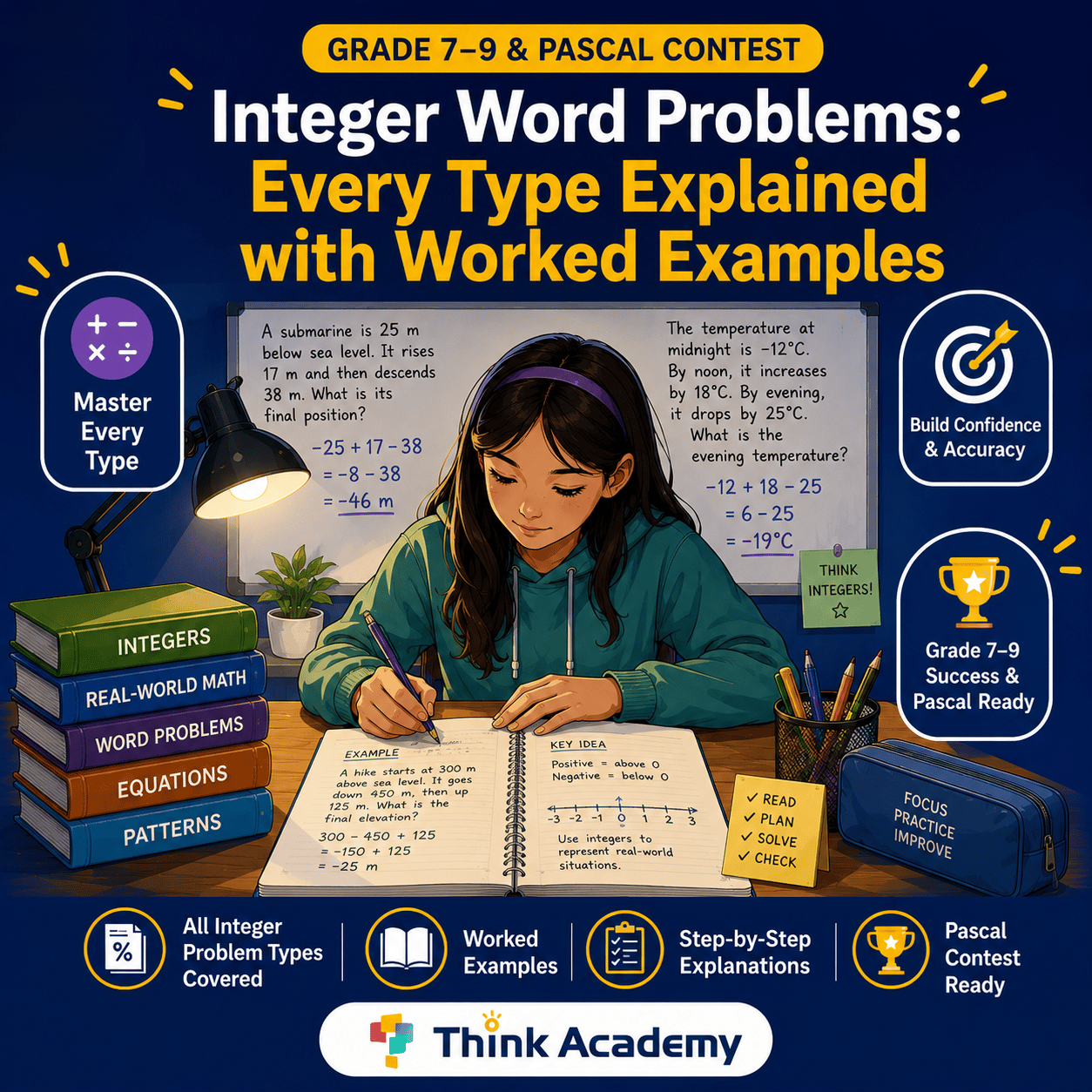
Integers — positive numbers, negative numbers, and zero — appear in real-world contexts that students encounter from Grade 6 onward: temperature, elevation, debt, sea level, profit and loss. Integer word problems are where the rules of integer operations get tested in context, and they are where students who learned the rules procedurally start to make mistakes. This guide covers every type of integer word problem that appears in Ontario Grade 7–9 math and the Pascal Contest, with clear methods, fully worked examples, and practice problems with solutions.

Integer word problems: What are integers?
Integers are the set of whole numbers and their negatives, including zero:
… −4, −3, −2, −1, 0, 1, 2, 3, 4 …
They do not include fractions or decimals. In the Ontario curriculum, integers are introduced formally in Grade 6 (ordering and comparing), extended to addition and subtraction in Grade 7, and extended to multiplication and division in Grade 8.
Integer word problems require students to:
- Identify whether a quantity is positive or negative from the context
- Choose the correct operation
- Apply the integer operation rules correctly
- Interpret the result in context
Steps 1 and 4 are where most marks are lost in word problems — not in the arithmetic itself.
Integer operation rules: a quick reference
Before working through problem types, these are the rules students need to know fluently.
Addition and subtraction
| Situation | Rule | Example |
|---|---|---|
| Adding two positives | Result is positive | 5 + 3 = 8 |
| Adding two negatives | Result is negative | −5 + (−3) = −8 |
| Adding a positive and a negative | Subtract the smaller absolute value from the larger; sign follows the larger | −8 + 3 = −5 |
| Subtracting an integer | Add the opposite | 7 − (−3) = 7 + 3 = 10 |
Multiplication and division
| Situation | Rule | Example |
|---|---|---|
| Same signs | Result is positive | (−4) × (−3) = 12 |
| Different signs | Result is negative | (−4) × 3 = −12 |
| Division follows the same sign rules | (−12) ÷ (−4) = 3 |
The four types of integer word problems
| Type | Context | Key language |
|---|---|---|
| Temperature and change | Rising and falling temperatures | ‘dropped’, ‘rose’, ‘below zero’, ‘above zero’ |
| Elevation and depth | Above and below sea level | ‘below sea level’, ‘altitude’, ‘descended’, ‘climbed’ |
| Financial | Profit, loss, debt, deposits, withdrawals | ‘earned’, ‘spent’, ‘debt’, ‘profit’, ‘loss’, ‘withdrew’ |
| Multi-step and mixed | Combining multiple integer operations | ‘overall change’, ‘net result’, ‘total after’ |
Integer word problems – Type 1: Temperature problems
Temperature is the most natural context for integers. Temperatures above zero are positive; temperatures below zero are negative.
Worked example 1: Temperature drop
The temperature in Winnipeg was −8°C in the morning. By evening it had dropped a further 11°C. What was the evening temperature?
Setup: Start at −8. Drop 11 more degrees means subtract 11. −8 − 11 = −8 + (−11) = −19°C
Worked example 2: Temperature rise
The overnight low in Ottawa was −14°C. By midday the temperature had risen 23°C. What was the midday temperature?
Setup: Start at −14. Rise of 23 means add 23. −14 + 23 = 9°C
Worked example 3: Temperature difference
Toronto recorded a high of 6°C and a low of −9°C on the same day. What was the difference between the high and low temperatures?
Setup: Difference = high − low = 6 − (−9) = 6 + 9 = 15°C
Type 2: Elevation and depth problems
Elevation above sea level is positive; depth below sea level is negative.
Worked example 4: Descent
A submarine is at an elevation of −45 m (45 m below sea level). It descends a further 78 m. What is its new elevation?
Setup: −45 − 78 = −45 + (−78) = −123 m
Worked example 5: Change in elevation
A hiker starts at an elevation of 340 m above sea level and descends to a point 80 m below sea level. What is the total change in elevation?
Setup: Change = final − initial = −80 − 340 = −420 m
The total change is −420 m, meaning the hiker descended 420 m overall.
Worked example 6: Multi-step elevation
A drone starts at ground level (0 m), rises 85 m, then descends 120 m. What is its final elevation?
Setup: 0 + 85 − 120 = 85 − 120 = −35 m
The drone is 35 m below ground level — this would typically indicate it has landed somewhere lower than its starting point, or is underground.
Type 3: Financial problems
Positive integers represent money received or gained; negative integers represent money spent or lost.
Worked example 7: Bank account
A bank account has a balance of $215. Three withdrawals of $80, $65, and $120 are made. What is the new balance?
Setup: 215 − 80 − 65 − 120 = 215 − 265 = −$50
The account is overdrawn by $50.
Worked example 8: Profit and loss
A small business made a profit of $1,200 in January, a loss of $450 in February, and a profit of $780 in March. What was the overall result for the three months?
Setup: 1200 + (−450) + 780 = 1200 − 450 + 780 = $1,530 profit
Worked example 9: Multiplication in financial context
A company loses $340 per day for 6 days. What is the total change in the company’s finances?
Setup: (−340) × 6 = −$2,040
The company’s finances changed by −$2,040 (a loss of $2,040).
Worked example 10: Division in financial context
A business incurred a total loss of $2,400 over 8 months. If the loss was equal each month, what was the monthly loss?
Setup: −2400 ÷ 8 = −$300 per month
Type 4: Multi-step and mixed problems
These combine multiple operations and often require students to work through several steps before reaching the final answer.
Worked example 11: Average temperature
The temperatures recorded over five days were: −6, 3, −2, 8, −3. What was the average daily temperature?
Setup: Sum = −6 + 3 + (−2) + 8 + (−3) = 0 Average = 0 ÷ 5 = 0°C
Worked example 12: Net position
A submarine starts at −30 m, rises 45 m, descends 60 m, then rises 25 m. What is its final position?
Setup: −30 + 45 − 60 + 25 = −30 + 45 = 15 = 15 − 60 = −45 = −45 + 25 = −20 m
Worked example 13: Pascal-style problem
The temperature at the top of a mountain is −12°C. The temperature decreases by 3°C for every 200 m of altitude gained. If the summit is 800 m higher than the current position, what is the temperature at the summit?
Setup: Altitude gain = 800 m. Number of 200 m steps = 800 ÷ 200 = 4. Temperature change = 4 × (−3) = −12°C Summit temperature = −12 + (−12) = −24°C
This type of multi-step integer problem — where multiplication and addition of integers are combined in a real-world context — is typical of Pascal Contest Part B problems.
Integer word problems in the Ontario curriculum
Integer word problems appear across several grades in Ontario:
| Grade | Integer content |
|---|---|
| Grade 6 | Ordering and comparing integers; introduction to negative numbers in context |
| Grade 7 | Adding and subtracting integers; solving contextual problems with + and − |
| Grade 8 | Multiplying and dividing integers; multi-step integer problems; order of operations with integers |
| Grade 9 (MTH1W) | Integer operations in algebraic contexts; rational numbers extending integers |
The most common contexts in Ontario curriculum word problems are temperature, elevation, and financial scenarios. EQAO Grade 6 includes simple integer comparison and ordering; by Grade 9, integer reasoning is embedded across multiple strands.
Integer word problems and the Pascal Contest
The Pascal Contest is written by Grade 9 and 10 students and tests mathematical reasoning across the curriculum. Integer word problems appear in two main forms:
Direct application: Part A problems (worth 5 marks) sometimes include straightforward integer word problems — temperature changes, net financial positions, or elevation problems — where the key skill is correct operation selection and sign handling.
Embedded integer reasoning: Part B and Part C problems often require integer arithmetic as a step within a larger problem. A student who makes a sign error on an intermediate step will get the final answer wrong even if the rest of their reasoning is correct. Fluency with integer operations prevents avoidable errors on harder problems.
The most common integer mistakes in Pascal problems:
- Subtracting a negative and getting a smaller number (forgetting that subtracting a negative adds)
- Multiplying a negative by a negative and getting a negative result
- Misidentifying which quantity is positive and which is negative from the word problem context
Percentages in word problems also come up often in the Pascal contest. See more here.
Practice problems
Try these before checking the solutions below.
Q1. The temperature in Thunder Bay was −17°C. It rose 24°C during the day. What was the afternoon temperature?
Q2. A diver is at −18 m. She ascends 7 m, then descends 15 m. What is her final depth?
Q3. A business had a profit of $2,300 in April and a loss of $3,100 in May. What was the net result over the two months?
Q4. The temperature dropped by 4°C each hour for 6 hours. If the starting temperature was 5°C, what was the temperature after 6 hours?
Q5. Over 5 days, a stock changed in value by +12, −8, +3, −15, and +6 dollars. What was the overall change in value?
Solutions
Q1. −17 + 24 = 7°C
Q2. −18 + 7 = −11. Then −11 − 15 = −26 m
Q3. 2300 + (−3100) = −$800 (a net loss of $800)
Q4. Temperature change = 6 × (−4) = −24. Final temperature = 5 + (−24) = −19°C
Q5. 12 + (−8) + 3 + (−15) + 6 = 12 − 8 + 3 − 15 + 6 = −2 (a decrease of $2)
Common mistakes in integer word problems
| Mistake | How to avoid it |
|---|---|
| Subtracting a negative and making it smaller | Subtracting a negative is the same as adding: a − (−b) = a + b |
| Assigning the wrong sign to a context | Re-read: is this a gain or a loss? Above or below? Rising or falling? |
| Getting the sign wrong when multiplying | Same signs → positive; different signs → negative |
| Adding instead of subtracting for ‘difference’ | Difference = larger − smaller; with integers, this means final − initial |
| Forgetting to interpret the result | A negative balance means overdrawn; a negative elevation means below sea level — always state what the number means |
How Think Academy Canada supports Grade 7–9 math and Pascal preparation
Think Academy Canada works with high-performing Ontario students from Grade 1 through Grade 12. For students in Grades 7 to 9, integer operations are a foundational skill that runs through number sense, algebra, and data — and a student who is not fully confident with integer word problems will make avoidable errors across all three strands.
Our approach starts with a free diagnostic. Every new student completes a short assessment and receives a personalised feedback report identifying where their skills stand. For students in Grades 7 and 8, the report typically shows whether integer difficulties are in sign rules, operation selection, or multi-step reasoning — three distinct problems with different solutions.
For students preparing for the Pascal Contest or building toward Grade 9 EQAO, integer fluency is one of the fastest skills to consolidate with targeted practice. A student who is losing marks on integer word problems is almost always making one or two consistent mistakes — and those are fixable.
FAQ
What are integer word problems?
Integer word problems are real-world problems that require using positive and negative whole numbers. Common contexts include temperature (above and below zero), elevation (above and below sea level), and financial situations (profit, loss, debt, deposits, withdrawals).
What are the rules for integer operations?
For addition and subtraction: adding two negatives gives a negative; adding a positive and negative gives the sign of the larger absolute value; subtracting an integer means adding its opposite. For multiplication and division: same signs give a positive result; different signs give a negative result.
How do you set up an integer word problem?
Read the problem and identify which quantities are positive and which are negative from the context. Identify the operation — is the problem asking for a total (add), a change (add or subtract), a difference (subtract), a repeated change (multiply), or a rate (divide)? Set up the calculation and apply integer rules.
What grade do students learn integers in Ontario?
Integers are introduced in Grade 6 (ordering and comparing). Addition and subtraction of integers are taught in Grade 7. Multiplication and division of integers are taught in Grade 8. Integer reasoning extends into algebraic contexts in Grade 9 (MTH1W).
Do integer word problems appear on EQAO?
Yes. Integer concepts appear on the Grade 6 EQAO (ordering and comparing) and are embedded in the Grade 9 EQAO across the Number and Algebra strands. Multi-step integer problems appear in the Grade 9 assessment.
Do integer word problems appear on the Pascal Contest?
Yes. The Pascal Contest (Grade 9–10) includes integer arithmetic in direct application problems and as a component of multi-step reasoning problems. Sign errors on intermediate steps are a common source of avoidable marks lost.
What is the most common mistake in integer word problems?
The most common mistake is subtracting a negative number and making it smaller, when in fact subtracting a negative increases the value (a − (−b) = a + b). The second most common is assigning the wrong sign to a contextual quantity — misidentifying a loss as a gain, or a descent as an ascent.
How do you find the difference between two integers?
Subtract the smaller from the larger, or calculate final − initial. With integers, this means applying the subtraction rule: if the result of final − initial is negative, the quantity decreased; if positive, it increased. For example, the difference between −9 and 6 is 6 − (−9) = 6 + 9 = 15.
How does integer reasoning connect to Grade 9 math?
In MTH1W (Grade 9), integer operations extend to rational numbers (fractions and decimals that can be positive or negative). Algebraic expressions and equations involve integer coefficients. Linear relations use integer slopes and intercepts. A student who is not fluent with integer arithmetic will make consistent errors across all of these.
How can Think Academy Canada help with integer word problems?
Think Academy Canada offers a free diagnostic assessment for students in Grades 1 to 12. The assessment identifies where a student’s integer reasoning stands — including whether difficulties are in sign rules, operation selection, or multi-step reasoning. A personalised feedback report is provided after the assessment, giving parents a specific starting point for targeted practice.
About Think Academy Canada Think Academy Canada is a K-12 mathematics tutoring programme, part of TAL Education Group. We work with motivated students across Canada from Grade 1 through Grade 12, with a focus on Ontario curriculum, EQAO preparation, and competition mathematics including CEMC contests (Pascal, Cayley, Fermat, Euclid) and AMC. All lessons are delivered online. Follow us on Instagram at @thinkacademyca.