


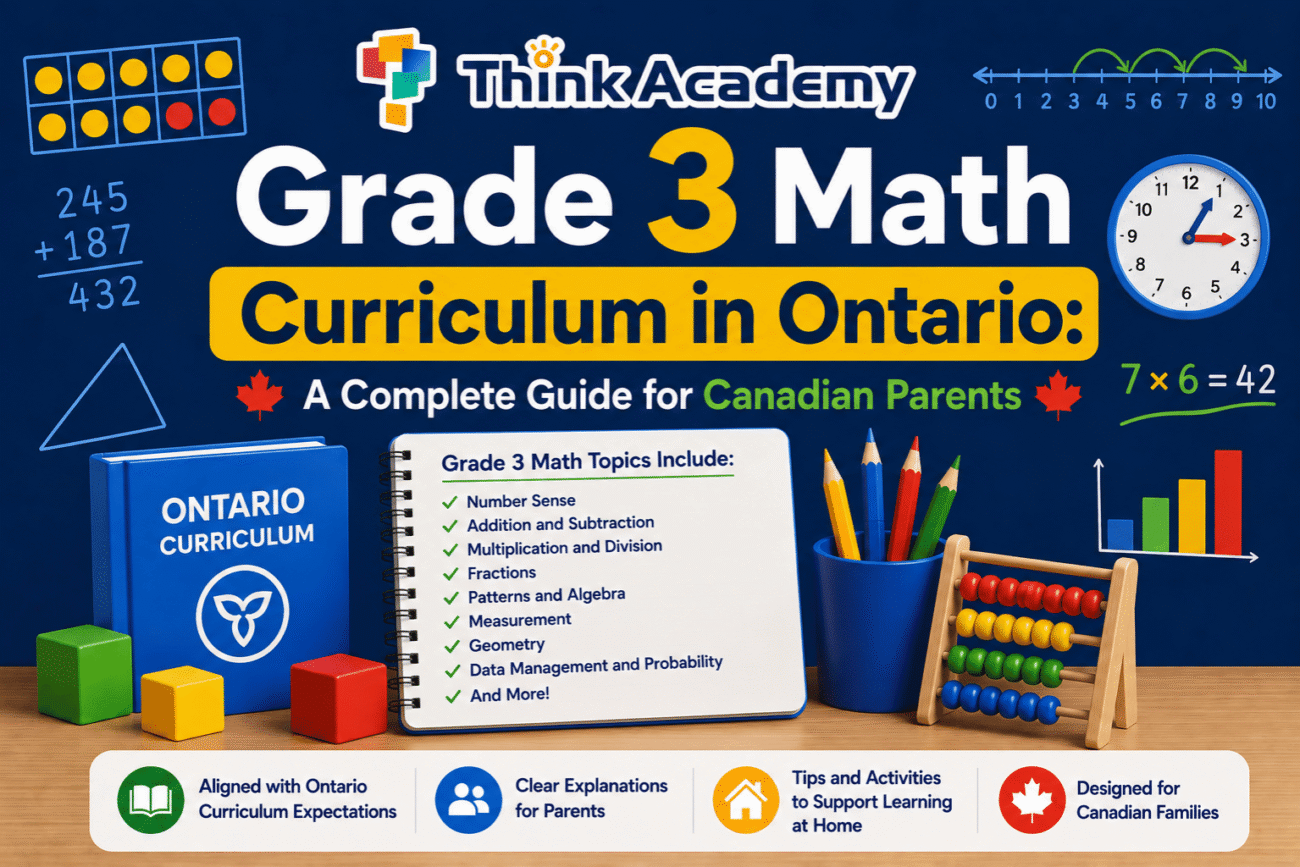
Grade 3 is an important year in a child’s mathematical development. Students move beyond basic counting and simple arithmetic into more complex problem-solving, multiplication, division, fractions, measurement, and data analysis. It is also the first year students participate in the EQAO assessment, making it a key milestone for many Ontario families. For parents, Grade 3 often provides the first clear indication of whether a child is comfortably meeting grade-level expectations or may benefit from additional support or enrichment. This guide explains exactly what students learn in the Ontario Grade 3 math curriculum, the skills they should master, and how parents can help them succeed.
What Is the Grade 3 Math Curriculum in Ontario?
The Ontario Grade 3 math curriculum is organised into six strands:
| Strand | What Students Learn |
|---|---|
| Number | Multiplication, division, fractions, place value |
| Algebra | Patterns, relationships, introductory coding |
| Data | Graphs, data collection and interpretation |
| Financial Literacy | Earning, saving and spending money |
| Measurement | Time, mass, capacity, perimeter and area |
| Coding | Simple algorithms and computational thinking |
Students are expected to solve problems, explain their reasoning, and apply mathematics to everyday situations.
Parents looking for the bigger picture can also read our guide to the Ontario math curriculum across Grades 1-8.
Number Sense and Operations
Number sense remains the foundation of Grade 3 mathematics.
Students learn to:
- Read and write numbers to 1,000
- Compare and order numbers
- Add and subtract larger numbers
- Understand multiplication concepts
- Understand division concepts
- Work with simple fractions
Multiplication and Division
One of the biggest changes in Grade 3 is the introduction of multiplication and division.
Students begin learning:
| Multiplication | Division |
| Repeated addition | Equal sharing |
| Multiplication facts | Equal grouping |
| Arrays | Basic division strategies |
Students are not expected to memorise every fact immediately, but they should begin developing fluency.
Fractions
Students are introduced to fractions such as:
- 1/2
- 1/3
- 1/4
They learn to:
- Identify fractions
- Represent fractions visually
- Compare simple fractions
Parents may also find our guide on converting fractions into decimals useful as students continue progressing through elementary mathematics.
Algebra and Patterning
The Grade 3 Ontario math curriculum introduces early algebraic thinking.
Students learn to:
- Identify repeating patterns
- Extend number patterns
- Describe relationships
- Predict future terms
These patterning skills become the foundation for algebra in later grades.
Coding
Ontario now integrates coding throughout mathematics.
Grade 3 students learn to:
- Follow simple algorithms
- Identify sequences
- Use logical thinking
- Predict outcomes
Coding is used to strengthen mathematical reasoning rather than teach programming.
Measurement
Students develop practical measurement skills.
Topics include:
Time
Students learn to:
- Read analog clocks
- Read digital clocks
- Calculate elapsed time
Length, Mass and Capacity
Students estimate and measure:
- Length
- Height
- Weight
- Capacity
Perimeter and Area
Students begin exploring:
- Perimeter of simple shapes
- Area using square units
These concepts help students connect mathematics with the physical world.
Data Management
Students learn how to organise and interpret information.
Topics include:
| Topic | Examples |
| Surveys | Collecting information |
| Graphs | Bar graphs and pictographs |
| Data Interpretation | Drawing conclusions |
| Probability | Likelihood of simple events |
Students are expected to explain what data shows, not simply read values from a graph.
Financial Literacy
Financial literacy is incorporated throughout the Ontario curriculum.
Students learn about:
- Coins and bills
- Making purchases
- Earning money
- Saving money
- Comparing costs
These lessons help children see how mathematics applies to everyday life.
Grade 3 and EQAO
Grade 3 is the first year students participate in the EQAO assessment.
The test evaluates how well students apply the skills taught throughout the curriculum.
Topics commonly assessed include:
- Number sense
- Fractions
- Multiplication and division
- Measurement
- Data interpretation
- Problem-solving
Parents may find these resources helpful:
- EQAO Grade 3: The Complete Guide for Ontario Parents
- EQAO Grade 3 Practice Test: Free Guide and Sample Questions
- EQAO Practice Test: The Complete Guide for Ontario Parents
- EQAO Formula Sheet: What’s on It and How to Use It
How Grade 3 Prepares Students for Grade 4
Grade 3 introduces many concepts that become more advanced in Grade 4.
| Grade 3 Skill | Grade 4 Application |
| Multiplication facts | Multi-digit multiplication |
| Fractions | Equivalent fractions |
| Data interpretation | More advanced graphs |
| Measurement | Area and geometry |
| Patterns | Early algebra |
Strong Grade 3 foundations make future mathematics much easier.
Parents may also wish to explore our guide to the Grade 4 math curriculum in Ontario.
Common Areas Where Grade 3 Students Struggle
Multiplication Facts
Many students understand multiplication concepts but need practice developing fluency.
Word Problems
Students often know how to calculate but struggle to decide which operation to use.
Fractions
Fractions can feel abstract when first introduced.
Explaining Mathematical Thinking
Ontario places increasing emphasis on reasoning and communication.
Students are expected to explain how they reached an answer.
Is Your Child Working Above Grade 3 Level?
Some students quickly master grade-level concepts and are ready for additional challenge.
Signs may include:
- Learning new concepts quickly
- Enjoying puzzles and logic problems
- Solving problems in multiple ways
- Strong mental math skills
- Curiosity about more advanced topics
These students often benefit from enrichment opportunities beyond the classroom.
How Parents Can Support Grade 3 Math Success
Parents can help by:
- Practising multiplication facts regularly
- Encouraging mental math
- Playing number games
- Reviewing mistakes together
- Connecting mathematics to everyday situations
At this age, confidence often matters as much as content knowledge.
How Think Academy Canada Supports Grade 3 Students
At Think Academy Canada, we help ambitious students build strong mathematical foundations while developing problem-solving skills that extend beyond the classroom.
Our programmes support students through:
- Curriculum enrichment
- Problem-solving development
- Logical reasoning
- Advanced mathematical thinking
- Long-term academic preparation
Many families begin enrichment in Grade 3 because it provides years of opportunity for growth before high school.
Follow us on Instagram: @thinkacademyca
Frequently Asked Questions
What is taught in Grade 3 math in Ontario?
Students learn multiplication, division, fractions, measurement, data management, financial literacy, and introductory coding.
Is multiplication taught in Grade 3?
Yes. Multiplication is one of the most important new concepts introduced in Grade 3.
What fractions do students learn in Grade 3?
Students are introduced to simple fractions such as halves, thirds, and quarters.
Is Grade 3 math difficult?
For many students, multiplication and fractions represent a significant increase in difficulty compared with Grade 2.
What is the EQAO Grade 3 math test?
EQAO is Ontario’s provincial assessment that measures how well students apply Grade 3 curriculum expectations.
How can I help my child with Grade 3 math?
Regular practice, mental math activities, and discussing problem-solving strategies can be very effective.
Is coding part of the Grade 3 math curriculum?
Yes. Coding and computational thinking are integrated into mathematics instruction.
What is the most important Grade 3 math skill?
Multiplication and number sense are among the most important foundations for future learning.
How does Grade 3 prepare students for Grade 4?
Grade 3 introduces multiplication, fractions, measurement, and problem-solving skills that are expanded in Grade 4.
How do I know if my child is ahead in math?
A diagnostic assessment can help identify strengths, weaknesses, and opportunities for enrichment.
Are word problems important in Grade 3?
Yes. Students are expected to apply mathematical concepts to real-world situations.
What should a Grade 3 student know by the end of the year?
Students should be comfortable with multiplication, division, simple fractions, measurement, graphs, and problem-solving.
About Think Academy Canada
Think Academy Canada helps students build strong mathematical foundations through structured enrichment, advanced problem-solving, and long-term academic development. Our programmes support ambitious learners from elementary school through high school.
Instagram: @thinkacademyca

